Holiday Inn Express Barcelona City 22@ by IHG
Barcelona - Pallars, 203
Book now

Behind the centre of Barcelona lies the Collserola Natural Park, a green area where city dwellers go to cool off when the city temperatures get sweltering. The highest point of the park is Tibidabo, a hill more than 500 metres above sea level from which you can enjoy the best panoramic view of Barcelona.
Admiring this tireless city from above is a truly thrilling experience: you can almost feel the creative ferment, passion and joviality that characterises the Catalans, but the noises are far away and muffled.
Easily reached by funicular railway, or on foot for the more sporty, the Tibidabo hill with its many attractions – including Spain’s oldest amusement park, a futuristic tower (also panoramic), an imposing church and a network of forest paths – is a must-see destination for a relaxing day, far from the hustle and bustle of the city yet so close to the heart of Barcelona.
For a fun day out with the family or to be a child again, visit Tibidabo Park, one of the oldest amusement parks in the world and undoubtedly one of the best in terms of location.
Situated in a scenic location on Tibidabo Hill, this park opened in the early 20th century and is a true city institution, with more than 30 rides and attractions for children, teenagers and adults, plus numerous shows.
Strolling through the park is fun in itself, thanks to the spectacular panoramic views of the city, the fountains with interactive water features and the street artists performing along the paths in captivating musical or circus performances.
In addition to numerous bars and restaurants, you will find useful facilities that will make your visit more enjoyable, such as the cloakroom lockers and the drying cabin, very useful for those who have played with water and find themselves with wet clothes.
Among the Tibidabo park’s great attractions, the oldest is theEmbruixabruixes (The Wizards’ and Witches’ Den), a monorail with carriages that instead of running above the track are attached below, as if suspended.
Still in operation, this attraction has changed its name several times over the years (Aerial Railway, Aeromagic). It has recently been totally renovated, with the addition of audio and video effects, LED structures and holograms to meet the taste of contemporary audiences. You don’t have to be a Harry Potter fan to have the time of your life on this ‘magical’ sky train!
It has an old-world charm but very modern technology Aviò, a flight simulator inside a red plane that replicates the aircraft used for the first flight from Barcelona to Madrid in 1927. An attraction that will make your imagination soar!
If admiring Barcelona from the terraces of Tibidabo is not enough for you, you can climb even higher thanks to Giradabo, the park’s Ferris wheel. Located at the highest part of the mountain, it seems almost suspended in the sky! From up there you can enjoy an incredible view of the city and the sea.
Quite different emotions will be felt by the daring who dare to go through the door of Hotel Krüeger, an abandoned hotel-style house of horrors reminiscent of The Shining and home to the scariest characters in the history of literature, from Dracula to Hannibal Lecter. Can you keep from getting goosebumps?
Deserving a paragraph in itself is a unique attraction within the Tibidabo park, the Museu d’Automat. This highly original museum houses a precious treasure of yesteryear: a collection of more than 40 automaton puppets and models from the 19th and 20th centuries.
The oldest piece in the collection, Pallasso Mandolinista, dates back to 1880; some of these nostalgic automatons have been at the Tibidabo amusement park since its inauguration. It is possible to see some of them in operation.
A visit to this museum takes you back to a time when cinema and television did not exist and it was these toys made with ingenuity and meticulous craftsmanship that left people speechless with wonder. A must-see attraction for young and old!
You can choose from three different tickets for your visit to the Tibidabo amusement park:

In its grandeur, the Temple of the Sacred Heart (Temple Expiatori del Sagrat Cor) is visible from every point in the city.
Built by Enric Sagnier between 1902 and 1911, it is especially worth a visit for the large statue of Christ and the ornate portal.
A lift takes you to the top of the main tower from where a staircase leads to the outdoor terrace offering a splendid view of the city.
Beyond the summit of Tibidabo, the Collserola Park covers an area of 8000 ha, including paths and forests. Considered Barcelona’s natural lung, today it is an oasis of peace and recreation for the urban agglomeration and, thanks to its well-marked paths, is ideal for trekking and mountain biking.

Visible from every point in the city at a height of 270 metres, the telecommunications tower is a structure located on the side of the Tibidabo, in the Turò de la Vilana.
Designed by the English architect Norman Foster, it consists of a slender central concrete mast supporting the thirteen functional platforms where the transmission antennas are located, while the upper part, up to 190 metres, houses all the FM and VHF antennas.
The service building, located at the base to minimise environmental impact, is completely underground. The summit is reached by a glass lift that runs along the outside of the tower.
On a clear day, Montserrat and the Pyrenees can also be seen from the viewing platform, which offers a 360° view of the city.
In the following map you can see the location of the main places of interest mentioned in this article.

There are several ways to reach the Tibidabo hill. The most charming is to take the funicular (Funicular del Tibidabo) that runs from Plaça Doctor Andreu up through the woods to Plaça de Tibidabo at the top of the hill. The funicular runs from 11:00 a.m. until 15 minutes after the amusement park closes. Those who enter the amusement park are entitled to a discounted ticket for the funicular.
To reach Plaça Doctor Andreu from the centre of Barcelona you have to take the FGC train line 7 and then bus 196.
An easier and cheaper, but less charming way is to take the T2A bus or Tibibus, which connects the central Plaça de Catalunya to Plaça de Tibidabo with runs about every 20 minutes.
If you are comfortable travelling by metro, take the L3 or L5 (recommended stops: Vall d’Hebron or Montbau) and from Paseo de la Vall d’Hebron, right in front of the hospital, the T2B bus.
If you are used to walking you can also walk up to the top of Tibidabo, but plan on at least an hour and a half starting from Plaça Doctor Andreu.
The Tramvia Blau is one of the old trams that used to run in Barcelona, featuring an old-fashioned wooden interior and hand bells.
Although a tourist attraction in itself, the blue trams have the particularity of passing through an area of tourist interest full of stately modernist houses, from the FGC station at Plaça Doctor Andreu to the end of Avinguda Tibidado.
As of 1 February 2018, it is not in operation due to a renovation, however, it is possible to take the equivalent route via Avinguda del Tibidabo to Plaça del Doctor Andreu square with bus line 196, which runs daily from 7.30 a.m. to 10 p.m.
To see all the facilities and book accommodation in Tibidabo use the form below, entering the dates of your stay.
The Tibidabo park is located outside the city, northwest of the centre of Barcelona, on a hill with a beautiful view.
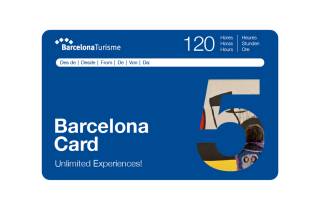
City Card allow you to save on public transport and / or on the entrances to the main tourist attractions.
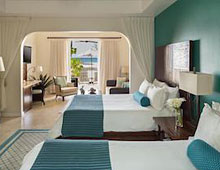 Hotel
Hotel 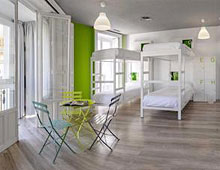 Budget accommodations
 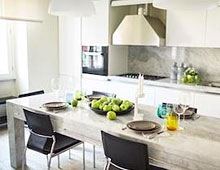 Apartments
  Family Hotel
  Luxury Hotel
  Resorts