
Bestseller
Barcelona: Sagrada Familia Entry Ticket with Audio Guide
From 33,80 €
Buy the ticket
With its full name ‘Temple Expiatori de la Sagrada Família’, Barcelona’s Sagrada Família is considered one of the symbols of the city, as well as the representative masterpiece of architect Antoni Gaudí, who dedicated the last part of his life to it, expressing all his artistry.
Still under construction, today the Sagrada Familia consists of two façades (Nativity and Crucifixion), the flanks, part of the apse and the left transept. The roof and some of the spires are among the most recent additions.

The original design included three façades, dedicated respectively to the Birth, Crucifixion and Resurrection of Jesus, seven naves and eighteen towers that were to represent, in ascending order of height, the 12 Apostles, the 4 Evangelists, Our Lady and, the tallest of all, Jesus. The 4 towers of the Evangelists were inaugurated on 12 November 2023 with a mass followed by the switching on of the lights. The tower dedicated to the Virgin Mary was also completed, and now a huge star stands on top of it. The central tower, dedicated to Jesus Christ, is scheduled for completion in 2026.
The evangelists’ towers are topped by sculptures of their traditional symbols: a man, a bull, an eagle and a lion. The central tower of Christ will be surmounted by a giant cross: the total height of the towers will be one metre lower than that of Montjuïc, as Gaudí believed that his work should not surpass that of God. The lower towers are topped by bunches of grapes, representing the spiritual fruit.
Of the façades, the only one completed by Gaudí is the Nativity façade, decorated with sculptural groups depicting the birth of Jesus and hundreds of naturalistic elements. The façade of the Crucifixion, begun in 1978 and inaugurated in 2002, was designed by architect Subirachs, who was able to synthesise his own ideas and those of Gaudí, while adopting a more modern and less imposing style. It is particularly striking for its subtle, emaciated, tormented characters, including the figure of the crucified Christ.

Currently completed are the central naves, characterised by columns resembling enormous trees and a ceiling that seems to be formed by gigantic sunflowers, and the transept, including the choir and the rose window that will give it light. Computer modelling of the missing parts is currently in use, which makes it possible, for example in the case of the inner pillars of the church, to make identical pieces as they were conceived by Gaudi.
Specific areas of the sanctuary will be designated to represent various religious concepts such as, saints, virtues, sins and secular concepts such as regions of Spain, presumably each will have corresponding decorations.
Themes throughout the decoration include words from the liturgy. The towers are decorated with words such as ‘Hosanna’, ‘Excelsis’, and ‘Sanctus’; the large door of the Passion façade reproduces words from the Bible in various languages, including Catalan; and the Gloria façade is expected to be decorated with words from the Apostles’ Creed.
Finally, in the crypt of the basilica is buried his genius, whose tomb is visible from the museum.

The Sagrada Familia is Barcelona’s most visited attraction and to visit it you need to buy an entrance ticket or take part in a guided tour. There are different types of tickets – choose the one that suits you! We recommend that you visit at off-peak times, i.e. early in the morning or late in the afternoon.
Due to the large influx of visitors to Gaudi’s work, it is recommended that you book your tickets in advance directly online by clicking on the box below. By purchasing your ticket online, you can avoid the queues that form every day at the ticket offices.
Alternatively, to discover everything about Gaudi’s masterpiece you can have an expert guide accompany you on your visit. The cost is slightly higher than the entrance ticket and even buying this tour will save you time by avoiding queuing at the ticket office.
If in addition to the Sagrada Familia you want to visit other attractions such as the Parc Güell and take a sightseeing bus tour of the city, choose a combination ticket: you can save money compared to buying individual tickets for each attraction.
It is possible to visit the Sagrada Familia during these hours:
Last admission is always half an hour before closing time.

The Associació Espiritual de Devots de Sant Josep, founded in 1866 with the intention of promoting the construction of a temple dedicated to the Holy Family, received donations and purchased the land on which the church now stands.
The work was to have been carried out by the architect Francesc del Villar, but after disagreements with the Association, in 1883 Antoni Gaudí took over the task. He set up his own studio and literally settled in the church, committing himself to the construction of the basilica with extreme dedication.
He worked on the endless project for 40 years, including the last 15 of his life. Realising that the construction of the church would take decades, if not centuries, after his death, rather than exhausting resources by laying out the entire gigantic perimeter, the Catalan architect preferred to complete some sections of the building in height (especially in the apse), as if to leave his successors a precise testimony of the original idea.
After his death in 1926, work continued for a short time, interrupted by the outbreak of the Spanish Civil War; it then resumed from time to time in 1952 under the guidance of another architect, who changed the original design, which had been lost due to bombing during the civil war.
Financed thanks to the offerings of the faithful, construction came to a halt during the COVID-19 pandemic, but today it is progressing at a good pace, despite the high costs and the difficulty of the project. It is estimated that work could be completed by 2030.
In the meantime, however, the construction site has become atourist attraction, thanks to the tall towers, many of which are completed, from which one can enjoy an excellent view of Barcelona, and thanks to the museum that shows visitors the various phases, present and future, of the construction of the church.
Observing the work in progress with sculptors clinging to the spires, labourers carving large blocks of stone, scaffolding and scaffolding everywhere, allows visitors to get a better sense of the grandeur of the project.
The Sagrada Familia is located in theEixample district, on the right-hand side, just north ofAvinguda Diagonal, a stone's throw from the Sagrada Familia metro stop.
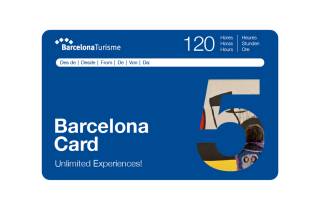
City Card allow you to save on public transport and / or on the entrances to the main tourist attractions.


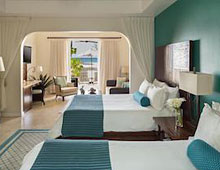 Hotel
Hotel 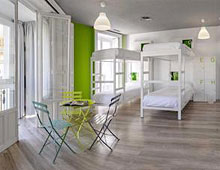 Budget accommodations
 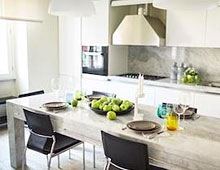 Apartments
  Family Hotel
  Luxury Hotel
  Resorts