The Ramblas are actually a set of streets one after the other; their northern end is Placa de Catalunya, while to the south they end at the Columbus Monument, continuing along the waters of Port Vell via the Rambla de Mar.
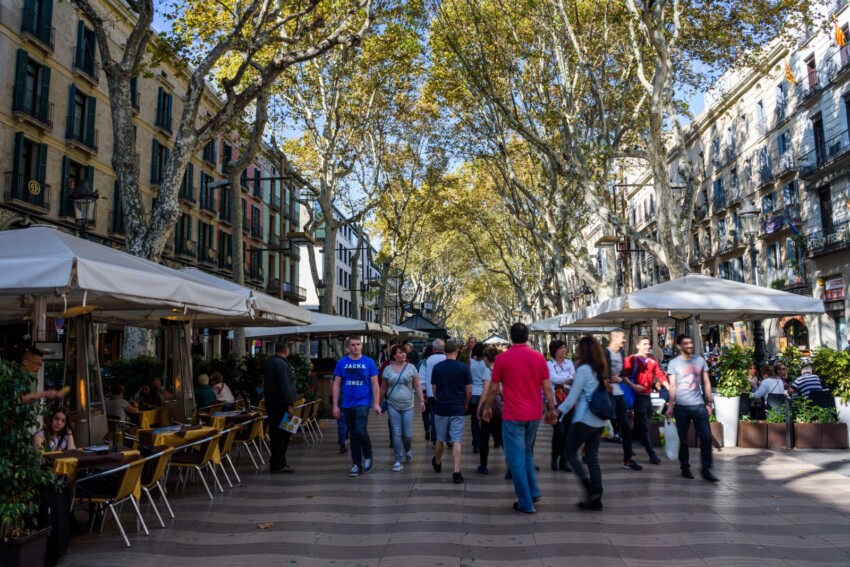
What would Barcelona be without Las Ramblas?
For many, this is where the spirit of the city is concentrated and is considered the best place to indulge in the Spanish ritual of the paseo (stroll). For the Ramblas, there is no rest: the flow of crowds flows uninterruptedly at all hours of the day and night.
The name Rambla derives from the Arabic word ‘ramla’ meaning ‘strand’. Originally, the Rambla was, in fact, a stream lined with walls and convents, and it was not until the 18th century that houses began to be built around the Boqueria market and eventually urbanised the street into the pedestrian area that everyone knows and admires today.
Generally known by the name Rambla, in reality Barcelona’s famous boulevard, which starts near Plaza de Catalunya and ends at the foot of the statue of Christopher Columbus, consists of five separate tree-lined avenues, each with its own name and history.
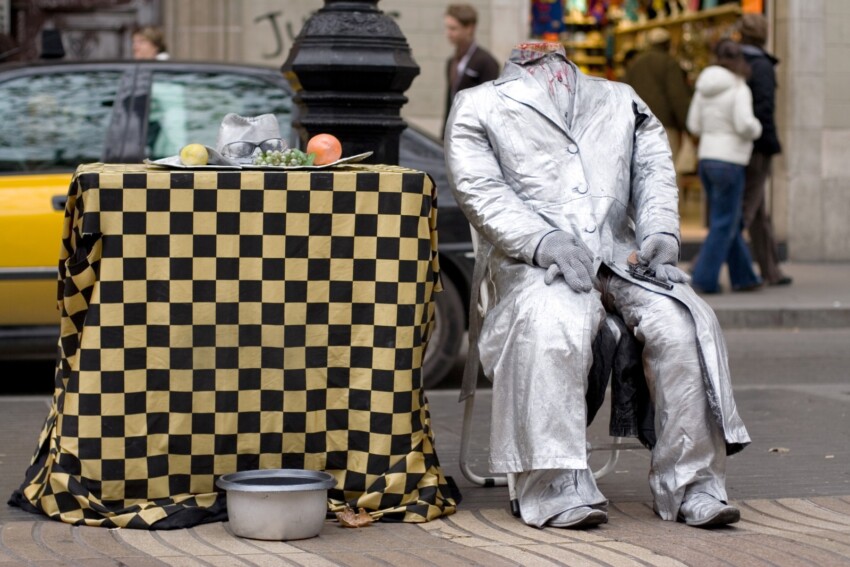
Strolling along the Rambles , one is strongly attracted by all that they offer: living statues, street musicians, mimes, caricaturists, vendors selling anything and everything, gamblers skilled in ‘bewitching’ tourists, fortune tellers, and so on and so forth. It is somehow like living in a storybook where at every hour there is something that surprises and attracts the attention of all passers-by.
Beware, however, of pickpockets hiding in the crowds, gypsies who try to swipe your wallet under the guise of selling you flowers, and cheats at the ‘find the ball’ game, which on the surface is a game of pure luck, but in reality is a rip-off!
Starting from the Plaça de Catalunya, the first one we encounter is the Rambla de Canaletes, then the Rambla dels Estudis, which, descending towards the sea is followed by the Rambla de les Flores, also known as the Rambla de Sant Josep.
This is followed by the Rambla dels Caputxins or del Centre, the Rambla de Santa Monica and, finally, the Rambla de Mar.
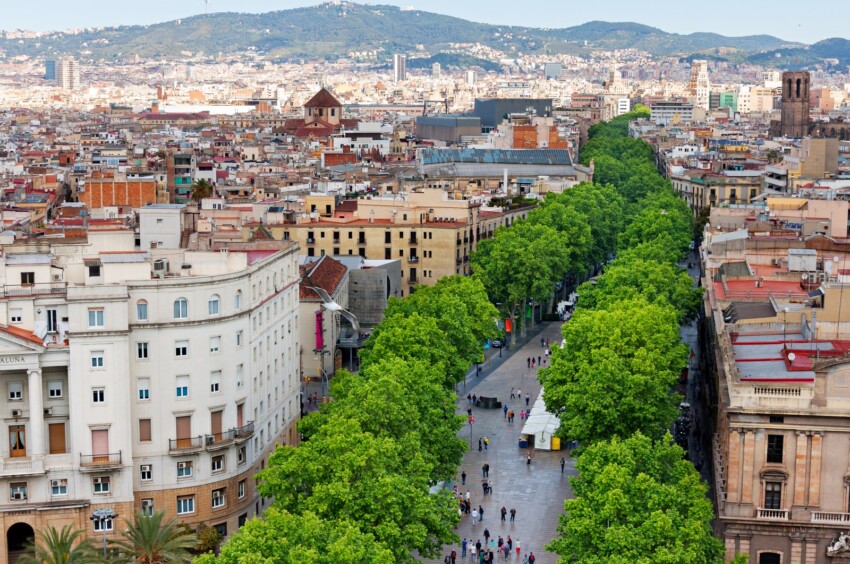
The first section of the Rambles takes its name from the Canaletes fountain, located since ancient times inside the Studio General, where the University now stands, and replaced in the 18th century by a more modern one, famous because its water seems to come from the Montcada mine.
And it is precisely around this water that a legend revolves, according to which anyone who drinks at this fountain, the equivalent of the Trevi Fountain in Rome, will return to Barcelona at least once.
On the Rambla de Canaletes there are many old shops, especially music shops, and it was here that Barcelona’s first ‘cocteleria’ was born in 1933, which made Havana and its excellent cocktails known to all.
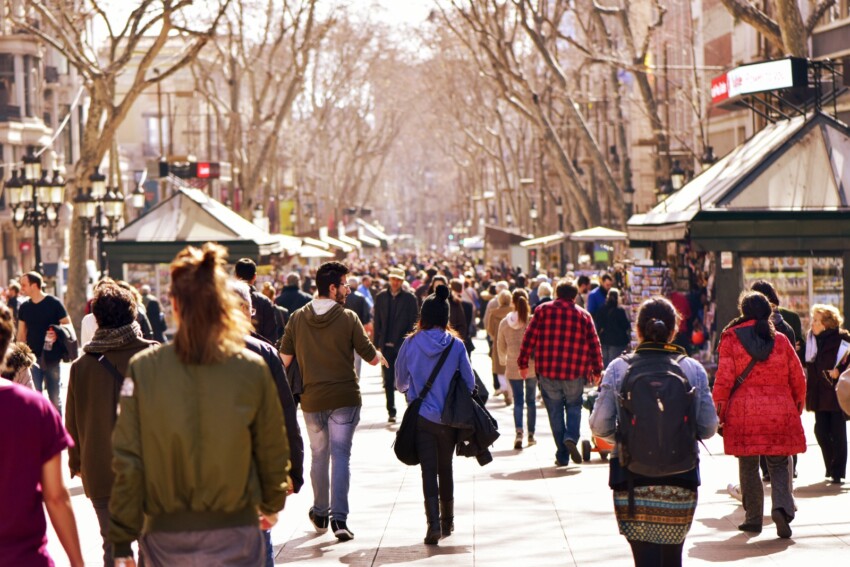
What characterises the Rambla dels Estudis is the traditional bird market, a colourful and sonorous constant presence for decades in the vicinity of the Portaferrissa Street.
Although some writers have renamed it Rambla dels Ocels, the name Rambla dels Estudis actually comes from the building of the Studio General or University. Suppressed by Felipe V to turn it into a neighbourhood, the building was finally demolished in 1843 to open the Isabel II Gate in the walls.
From this Rambla it is possible to visit the CCCB – Barcelona’s Centre for Contemporary Culture, the Poliorama Theatre, the Església de Betlem, Plaza de la Vila de Madrid and the Bagna Palace, also known as the Palace of the Marquis de Cornillas.
In the 19th century, the city’s only flower market was held here and Catalan impressionism was born here, with artists such as Ramón Casas who immortalised flowers and shoppers in beautiful works.
Today, in addition to the flower stalls, there are numerous kiosks displaying Italian and foreign books, newspapers and magazines.
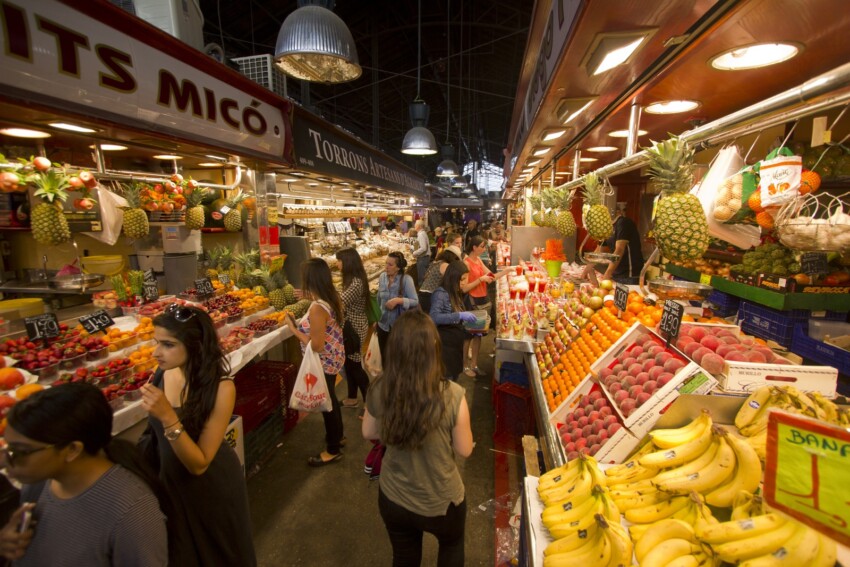
On the Rambla de les Flors (also called Rambla de Sant Josep) you will also find the traditional and famous Boqueria Market, a chaotic treasure trove of food, where everything from mountains of fruit to grilling pigs to live lobsters are for sale.
Also worth visiting are the Viceroy’s Palace, the Casa Beethoven music shop, the Casa dels Paraigües and the Palau Nou de la Rambla.
Also known as Rambla del Centro, the name Rambla de Caputxins comes from the Capuchin convent here.
Today, this stretch of Rambles is a meeting point for young groups, while on evenings when there is opera, it hosts groups of people from the Catalan bourgeoisie.
Sights: Joan Miró’s mosaic on the pavement at the beginning of the Rambla, towards Pla de la Boqueria; the Gran Teatre del Liceu, fully restored after the 1994 fire; Plaça Reial with its iron fountain of the Three Graces.
Descending towards the Theatre Square begins the last stretch of the Ramblas, the Rambla de Santa Monica, which is the entrance to the port.
Along it are some old buildings, such as the house of the photographer Napoleón, the Marc Palace of Reus, seat of the Conselleria de Cultura of the Generalitat of Catalunya, the Cannon Foundry, the old Credit and Docks building, and the Wax Museum.
At the end of the left side of the Rambla is the Church of Nuestra Señora de la Mercede, while on the opposite side is the Main Theatre.
Descending below this area, there is the street called Arc del Teatre that joins the Avenue del Parallel with the Rambla.
And further down is the former convent of the Discalced Augustinians from 1626, which now houses the Santa Monica Art Centre.
Also worth a visit are the Church of Santa Monica, with its austere Baroque cloister, and the Drassanes, or Arsenals, the city’s most important civil Gothic building.
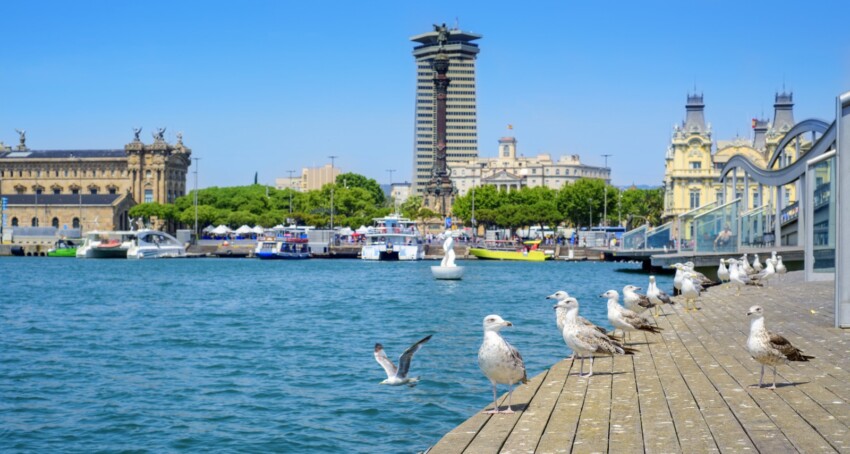
At the end of Las Ramblas is the monument to Christopher Columbus, one of the monuments dearest to the people of Barcelona. It is a huge statue of the explorer placed on top of a 60-metre high statue. A lift allows you to reach the top, from where you can enjoy a splendid view of the Montjuic harbour.
The last stretch of the Rambles is the Rambla de Mar, although it is actually a corrugated wooden walkway that passes over the water to the start of the Maremagnum, a complex of shops, clubs and fast food outlets as well as an IMAX cinema showing 3D films usually related to sports, nature and adventure on mega-screens.
The Ramblas are actually a set of streets one after the other; their northern end is Placa de Catalunya, while to the south they end at the Columbus Monument, continuing along the waters of Port Vell via the Rambla de Mar.
City Card allow you to save on public transport and / or on the entrances to the main tourist attractions.




 Hotel
Hotel  Budget accommodations
  Apartments
  Family Hotel
  Luxury Hotel
  Resorts