Bestseller
Barcelona: Park Güell Admission Ticket
From 21,50 €
Buy the ticket
Among the unmissable works of Gaudí that await you during your holiday in Barcelona is undoubtedly Park Güell. This extraordinary complex was born in the early 20th century from the mind of Eusebi Guell, a wealthy Barcelona businessman who decided to create a garden-city, i.e. a neighbourhood quite distinct from the rest of urbanisation, in which buildings and greenery would intertwine seamlessly. This is also why he chose to build it on a slope of the Carmel hill, a few kilometres away from the centre, in the La Salut district.
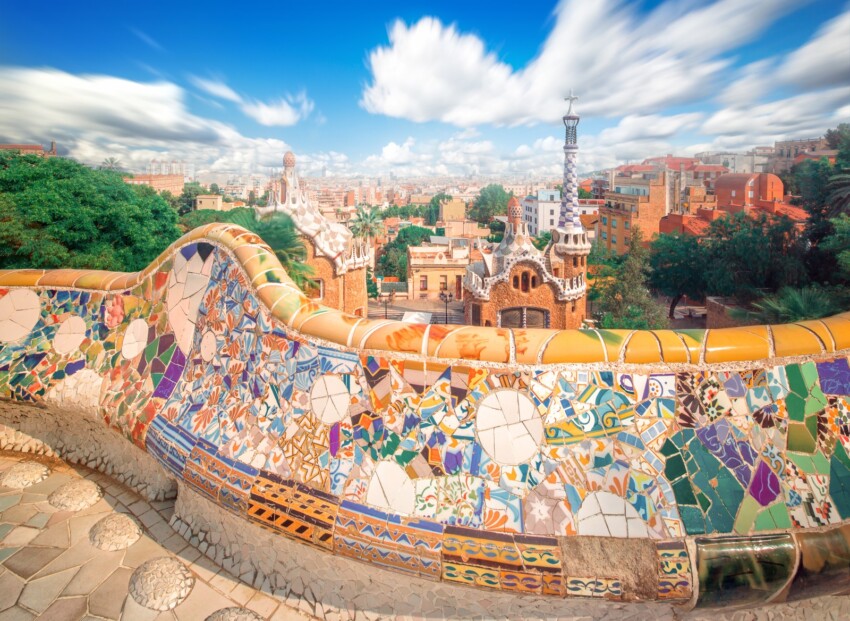
Today, over a hundred years later, we can say with certainty that unfortunately his idea failed, and the garden city never saw the light of day. However, thanks to the fact that the architect entrusted with the task was Antoni Gaudí, who – as always – gave his best, Parc Guell is still one of the most visited and photographed attractions in Barcelona. And the reason is easily said: it is a unique mix of modernist architecture, a public park and a rooftop terrace, from which you can admire a crazy panorama, a view that sweeps all the way to the Mediterranean Sea, with the icons of the city skyline clearly visible, including the Sagrada Familia and the Glories Tower.
Visiting the Park Güell will easily take you half a day, between the time spent getting there and the actual visit. Time well spent, however, which can be even longer if you combine your visit to the park with a visit to the Gaudí House Museum, the residence of the eclectic Barcelona architect who lived here in the last years of his life.

The park was designed and composed to bring peace and serenity: the buildings flanking the entrance, although very original, colourful and in full Gaudí style with pinnacles and pointed roofs, fit perfectly with the park’s purpose as a relaxation area.
The Gaudí House Museum, located within the Parc Güell, was Gaudí’s residence for twenty years. Today it is a museum housing a collection of furniture and objects designed by the famous architect, as well as works by his other collaborators.
The building consists of four floors: the ground and first floors are dedicated to collections open to the public, while the other two are for private use. The second floor houses the Enric Casanells library, which can only be accessed after requesting a permit.
The most visited place in the park is the main terrace, called Plaza de la Naturaleza and surrounded by a long bench in the shape of a sea snake. The curves of the bench, which follow the sinuosity of the snake, create a deliberately social atmosphere; Gaudí also incorporated numerous references to Catalan nationalism, as well as elements of religious mysticism and ancient poetry.
From the terrace you can admire a unique view of Barcelona, with the Sagrada Familia, the Agbar Tower and the Montjuic area.
A double flight of steps starts at the entrance to the park, flanked by two walls that form a terrace under which two caves open out: the one on the right served as a place to house horses and is supported by a magnificent conical central column.
The staircase is organised in three parts, through which water flows from a spring fed by a cistern located under the adjacent Sala Hipostila. Halfway up the staircase is the shield of Catalonia and higher up is the dragon, or salamander, covered in mosaics, which over the years has become the park’s most popular image.
The grand staircase of the dragon leads to the Hipostila Hall, originally intended to house the market of the urbanisation that was to have taken place. It is made up of 86 columns inspired by the Doric order, the outermost of which incline in an undulating movement contrary to all rules of classical composition, to reinforce the perception of their structural function. Inside the hall, the absence of columns creates a space that simulates three naves, as inside a large church.
If you want to delve deeper into the works of Gaudí, a few metres from the entrance to the Parc Güell, at Calle Larrard 41, the new interactive museum Gaudí Experiència will guide you through an exciting introduction to the works and ideas of the visionary artist in 4D cinema. Tickets are not included with admission to Parc Güell but can be purchased below.
The Parc Güell is now a municipal garden and can be visited free of charge, although an entrance fee is required to access the monumental area. There are different types of tickets: choose the one that suits you! The best time to visit the park is early in the morning or late in the afternoon.
The Parc Güell is one of the most visited attractions in Barcelona throughout the year, so we recommend you buy your ticket a few days in advance to guarantee your access and to avoid queuing at the ticket office. This ticket does not include live guides or audio guides.
For a complete visit and to discover the history and anecdotes in the making of the park, you can purchase the ticket for a guided tour: it includes skip-the-line tickets and a guide who will accompany you on the tour.
If in addition to the Parc Güell you want to visit other attractions such as the Sagrada Familia and take a sightseeing bus tour of the city, choose a combination ticket: you can save money compared to buying individual tickets for each attraction.
The park is open every day of the year with the following opening hours:

Well aware that the urbanisation of this area would drastically reduce the green space in the city, the entrepreneur and industrialist Eusebi Güell decided to build a residential area for the city’s rich bourgeoisie, entrusting the project to Antoni Gaudí. The park was therefore built between 1900 and 1914 although it was not officially opened to the public until 1926. In 1984,UNESCO listed Parc Güell as a World Heritage Site, along with Gaudí’s other works in Barcelona.
For the construction of Park Güell, Gaudí implemented a series of new structural solutions, adding creativity and freedom. Starting with a kind of baroque, the work acquired a structural richness of shapes and volumes. Gaudí envisaged the park as a kind of private garden for some of the villas that would be built later, equipping it with all the technology of the time to ensure maximum comfort for the owners, with a distinctive artistic touch.
However, Güell’s idea failed to take off: due to a lack of interest among buyers, the villas were never built except for the demonstration villa , which went unsold anyway and was bought directly by Gaudí, who moved in with his family in 1906 and lived there until 1926. Today, this house has become the Gaudí House-Museum and was declared a historic monument of national interest in 1969.
The Parc Guell marks the northern border of the Gracia district. Situated in a dominant position on a rise, it is accessed via Carrer d'Olot.
City Card allow you to save on public transport and / or on the entrances to the main tourist attractions.


 Hotel
Hotel  Budget accommodations
  Apartments
  Family Hotel
  Luxury Hotel
  Resorts