Bestseller
Barcelona: Museu Nacional d'Art de Catalunya Entrance Ticket
From 12,00 €
Buy the ticket
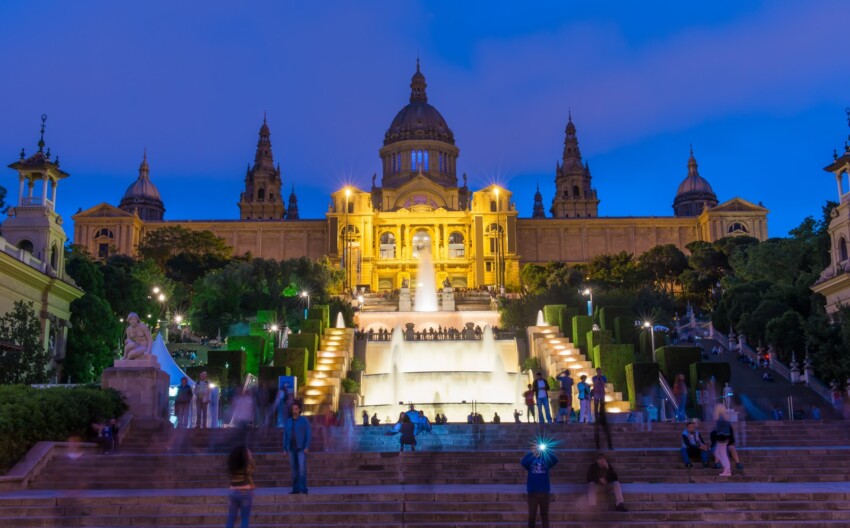
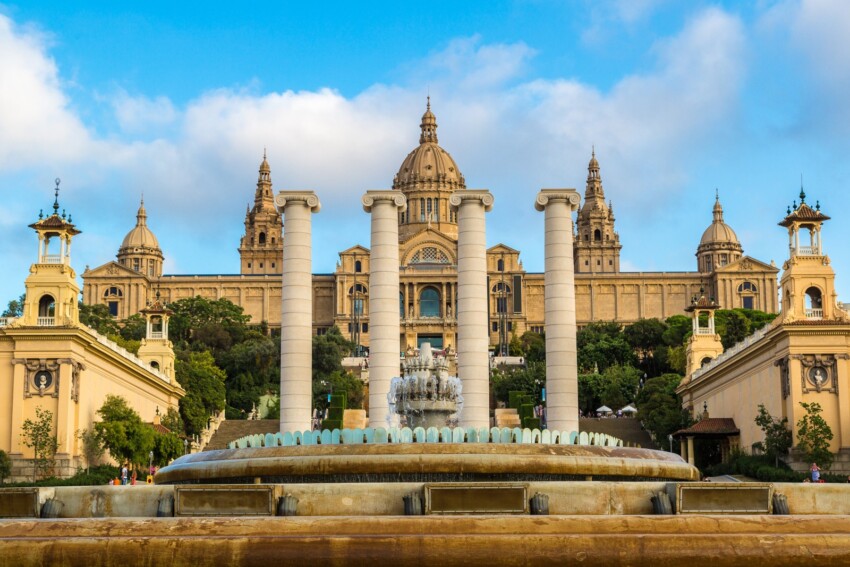
If you are in the majestic Placa d’Espanya, you cannot fail to notice the huge Palau Nacional building, located at the end of Avenida de la Reina Maria Cristina, in the direction of the dancing fountains and past the Venetian Towers.
Not only is it beautiful from the outside, but also from the inside, as it houses the Museu nacional d’art de Catalunya, or MNAC, which contains one of the world’s most extensive collections of Romanesque art, as well as an area dedicated to numismatics, one to engravings and a photography department, in addition to large sections showcasing Gothic, Renaissance and modernist art. In all, there are more than 250,000 works on display in the museum, not to mention the fact that temporary and travelling exhibitions are often set up and organised, making it even richer and more interesting.
The collections within the MNAC are many and all very interesting to visit. Of all of them, the Romanesque art section certainly stands out, where you can admire some beautiful frescoes and a series of works mainly created between the 10th and 13th centuries. Next comes the section dedicated to Gothic art, developed between the 13th and 15th centuries, after which comes the Renaissance and Baroque section, where you can admire works by the likes of Titian, Tintoretto, Rubens and many others. But the MNAC also has a section devoted to modern art, which reaches into the 20th century, thanks mainly to a series of works by the most important artists representative of Catalan modernism, including Gaudí and Casas.
In addition to traditional art, the MNAC also exhibits a very rich section dedicated to numismatics, with 135 thousand coins from the 6th century B.C. to the present day, and a last but certainly not least section, where you can admire no less than 100 thousand works including drawings, engravings and posters.
The Romanesque art collection of the MNAC is one of the most important in the museum, mainly due to the numerous frescoes it includes. Many of the works on display originally adorned churches in the Pyrenees and throughout Catalonia. The rooms of the Romanesque art collection are arranged in chronological and stylistic order, a choice that gives visitors a distinct viewpoint of the different trends in Catalan Romanesque art and the works produced during this current, mostly in the 11th, 12th and 13th centuries.
One of the most interesting works exhibited in this room of the museum are undoubtedly the paintings of Sant Joan in Boì, dating from around 1100. Only part of it remains intact to this day, but enough to reveal a rich iconography with extensive reference to the history of redemption. Other painted scenes include the lives of saints, including the stoning of St. Stephen, an extensive repertoire of natural and animal environments and a depiction of Judgement Day. Boi’s paintings are an excellent example of the French influence in Catalonia, different from the Italian influence that nevertheless dominated the Romanesque art scene in Catalonia.
The Gothic art collection of the Museu Nacional d’Art de Catalunya began to take shape in the first decades of the 20th century, in an attempt to revive and preserve the important Catalan heritage, which was seriously damaged in the fire of the Santa Caterina convent in 1835.
The Gothic wing of the museum showcases numerous works by Catalan artists, accompanied by an extraordinary selection of pieces and works from other territories once ruled by the Crown of Aragon.
There are works from the late 13th century, as well as from the 14th and 15th centuries, arranged in chronological order and grouped by school and affinity, thus creating several thematic sections, among which the mural painting of the Conquest of Majorca, which presides over the first room of the Gothic wing, stands out.
Much of the Museu Nacional d’Art de Catalunya ‘s fame, however, is due to its collection of modern art. It has its origins in the Universal Exhibition of 1888, from where it has expanded considerably and today this part of the museum contains a selection of the best Catalan art of the entire 20th century.
Works by Catalan neoclassical artists are on display, as well as works by Marià Fortuny, for many the best Catalan painter of the 19th century; his style was acclaimed by international critics despite the fact that at the end of his career he began to take an interest in pictorial innovation, as can be seen in his later works.
The styles exhibited in the modernist wing of the Museu Nacional d’Art de Catalunya are essentially modernism and noucentisme, a cultural movement that characterised the whole of Catalonia in the early 20th century, when it stole the stage from modernism, the style that had dominated the previous century.
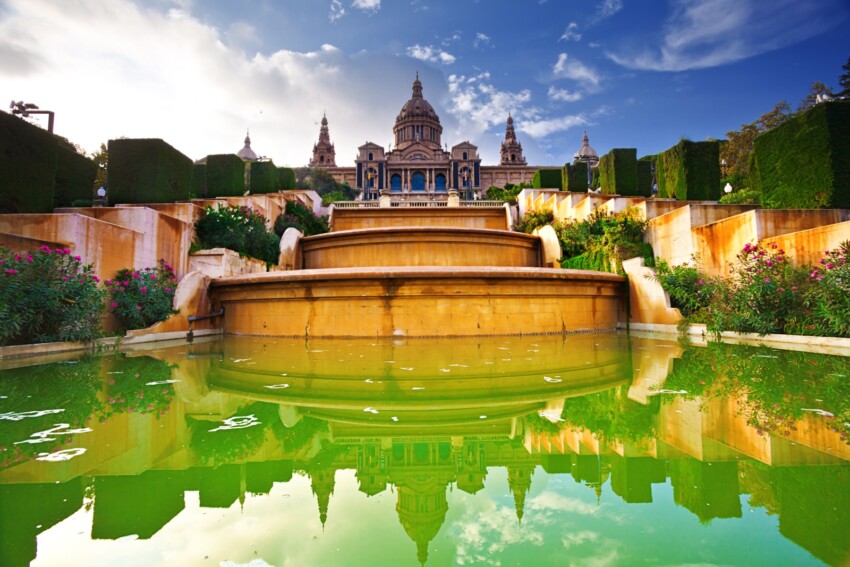
The National Art Museum of Catalonia is not only beautiful inside, but also outside. In fact, it is housed inside the sumptuous Palau Nacional, or Palau Nacional in Catalan, built to be the main venue of the 1929 International Exhibition in the Spanish Renaissance style. Local architects Eugenio Cendoya and Enric Catà were responsible for the project, under the supervision of the famous Pere Domènech i Roura.
The enormous palace covers over 30,000 square metres and is richly decorated with frescoes and interesting architectural elements. The Oval Hall and the Throne Room are very beautiful, while the enormous elliptical dome in the centre, richly frescoed and stuccoed, almost resembling that of a church, will certainly amaze you.
At night, the Palau Nacional is richly illuminated, both on the façade and in the background, where spotlights shooting light outwards from the centre of the palace give it a truly unique atmosphere.
You can buy your ticket directly at the museum’s ticket counters or online, in advance, to avoid the queue at the entrance and save time. The standard ticket extends with the possibility of access to the roof for a slight surcharge, and it is also possible to add an extra fee to hire an audio guide. There are reductions for students, while children under 16 and over 65 are entitled to a free ticket. Entrance to the MNAC is also free with the Barcelona Card.
Finally, remember that on Saturday after 3pm admission to the museum is free for everyone, as it is every first Sunday of the month.
If you want to visit other museums in Barcelona together with the MNAC, we recommend acquistare online l'ArtTicket Barcelona: the savings are considerable compared to buying tickets for individual museums. The museums and galleries included in ArtTicket Barcelona are: the MACBA (Museum of Contemporary Art), the Picasso Museum, the Antoni Tàpies Foundation, the Joan Miró Foundation, the MNAC (Museu Nacional d’Art de Catalunya) and the CCCB (Centre de Cultura Contemporània).
The MNAC is open from Tuesday to Sunday, with the hours varying according to the season.
The National Art Museum of Catalonia is closed on 1 January, 1 May and 25 December.
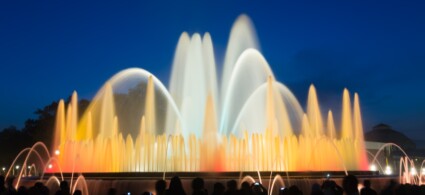
The MNAC is easily reached from two sides: from Placa d’Espanya and from Montjuic Hill. By metro, take one of the L1 or L3 lines and get off at the Espanya stop, located next to the Las Arenas shopping centre, cross the impressive square past the majestic Venetian towers, and past the Font Magica you’ll find the stairs that will take you directly to the museum entrance. Placa d’Espanya is also a very important transit hub, and therefore many bus lines stop here. Some of them are:
Alternatively, arriving there from Montjuic the route will certainly be less strenuous, as it is downhill. Unfortunately, you won’t be able to use the metro because it doesn’t pass through here, but alternatives for getting there, if you don’t have a hire car, include the funicular, cable car or tourist buses, as well as taxis of course.
The MNAC in Barcelona is located on the hill of Montjuic, opposite Placa d'Espanya.
City Card allow you to save on public transport and / or on the entrances to the main tourist attractions.

 Hotel
Hotel  Budget accommodations
  Apartments
  Family Hotel
  Luxury Hotel
  Resorts