Bestseller
Sant Pau Art Nouveau Site Ticket
From 18,00 €
Buy the ticket
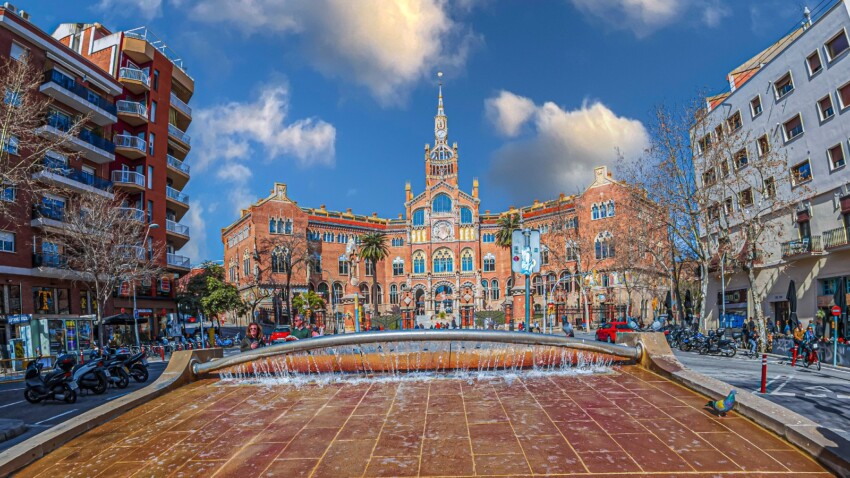
The Hospital of the Holy Cross and St. Paul is an incredible complex of modernist buildings, located in the El Guinardó neighbourhood, north of Barcelona between Gracia and the Sagrada Familia. It is one of the greatest splendours of Catalan modernism, designed by architect Lluis Domenech i Montaner, and together with the Palau de la Musica Catalana is part of a unique UNESCO heritage site.
Please note: behind Domenech i Montaner’s modernist buildings is a real, working modern hospital, also called Hospital de la Santa Creu i Sant Pau and opened in 2009. To avoid confusion and misunderstanding, the historical monument is simply called Recinte Modernista de Sant Pau for everyone in the city.
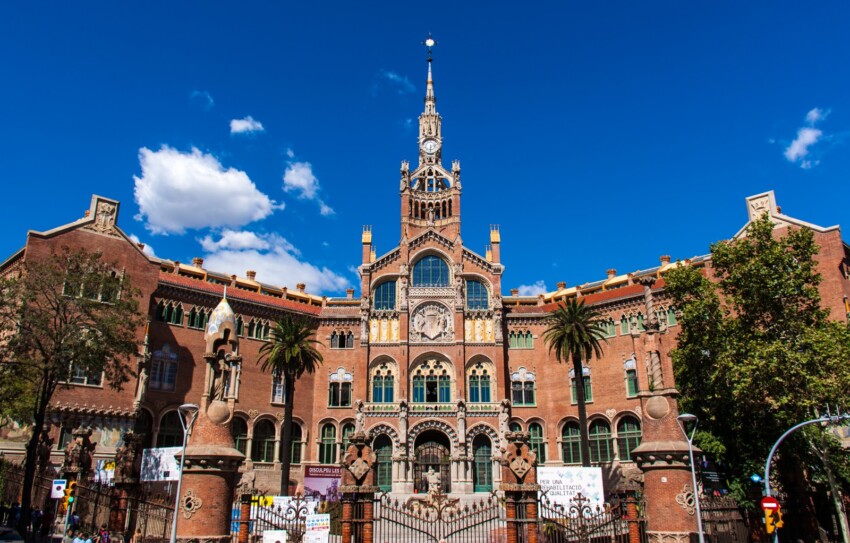
Consisting of 12 pavilions connected by a long series of underground tunnels in order to have a large green space on the surface, the Recinte Modernista is a huge complex in the style of – precisely – modernista, the Catalan equivalent of Art Noveau. Until 2009 it was a real hospital, but after being supplanted by the new structure and being closed for five years of restoration and redevelopment work, it reopened in 2014 as a museum and cultural centre.
The first pavilion you will visit is the one called Sant Salvador, where you will find waiting for you the history of the entire Hospital de la Santa Creu i Sant Pau, born in 1401 in what is now the Gothic Quarter and then moved here in the 20th century. On the first floor of the pavilion there is an installation that is somewhat of a symbol of the entire complex of buildings: it is a dragon, created to pay homage to Lluis Domenech i Montaner, the creator of the structure. You will then continue your visit outside the Recinte Modernista, to get an idea of what the prototype garden city of the early 20th century was like. You will then move freely from pavilion to pavilion: here are the most interesting ones:
During your visit, you will be able to move between pavilions, stroll through the lush garden and admire the works of art found throughout the buildings. In addition, part of the Administrative Pavilion has been converted into a conference and events centre, with capacity for over 600 people. Its splendid interior is ideal for corporate meetings, courses, conferences or presentations.
The visit to the Recinte Modernista can be enriched by aninteractive audio guide available at the entrance for an additional cost, which is carried out with a special tablet that will allow you to discover the secrets and anecdotes of this splendid structure. The audio guide is available in 9 languages, including Italian.
During the Christmas period, the Recinte Modernista lights up festively. In fact, this is the time each year when an audio-visual show called Els llums de Sant Pau (which translates as ‘the lights of Saint Paul’) is staged, where the large courtyard is lit up with an incredible amount of lights in a thousand colours and spectacular effects, and more than 20 Christmas-themed installations are set up to delight young and old, as well as a large ice rink.
An incredible experience for the whole family, which by the way is created differently every year: the perfect excuse to return to Barcelona during Christmas and visit this incredible attraction every time!
The opening dates of Els llums de Sant Pau vary from year to year, but roughly range from late November to mid-January. So check in advance, and buy your tickets online in good time to avoid the long queue at the ticket office.
Tickets for the Recinte Modernista can be purchased online or on site. It is worth considering buying in advance to be able to enter the building immediately once you arrive, without having to queue at the ticket office.
Reductions are available for residents of Barcelona, young people aged 12 to 29 and over 65, disabled people up to 65%, single parents and large families. On the other hand, the visit is free of charge for the unemployed, children under 12, the disabled of 65% and over and their carer, and the over-65s on the first Sunday of the month.
There are also discounts on the entrance ticket, amounting to 20% for BCN Card holders and for those who buy a tour bus tour, while the discount rises to 50% for those with a Ruta del Modernisme or Carnet Jove ticket, and for members of the Barcelona College of Doctors and Nurses.
The Recinte Modernista in Sant Pau is open every day of the week. From April to October access is permitted from 9.30 a.m. to 6.30 p.m., and from November to March from 9.30 a.m. to 5 p.m. It is possible to enter up to 30 minutes before closing time; bear in mind that the visit takes approximately 45-60 minutes.
A guided tour is the best way to discover Catalan Art Noveau and the entire complex of buildings of the Hospital de Sant Pau. You will have the opportunity to learn first-hand all the artistic details of the former hospital and the anecdotes that marked the evolution of this important institution in Barcelona during its centuries of history.
It is possible to hire a private guide and take part in the individual visit of the Recinte Modernista, or take the official guided tours, which take place on weekends and holidays, at 11 a.m. in Spanish and 12.30 p.m. in Catalan. The tour lasts 75 minutes and tickets can be purchased online or on site. Reductions follow those for standard tickets.
The structure was designed to occupy an area of 9 squares in the Eixample district, in a total area of 300×300 metres. The main building is dedicated to administration, while the others make up the medical and nursing areas. All the buildings that make up the Hospital de Sant Pau are connected by underground tunnels. The technical installations were built in the open air to facilitate their maintenance.
Architect Domenech collaborated with several artists on the project: the main ones were Pablo Gargallo and Eusebio Arnau, who made the numerous sculptures, and Francesc Labarta, who painted the frescoes and made the mosaics. Josep Perpinyà took charge of the wrought iron elements.
Themain entrance to the Hospital de la Santa Creu i Sant Pau is oriented at a 45° angle to the Eixample looking towards the Sagrada Familia. It is believed that the reason for this choice is that Domenech i Montaner wanted to take advantage of the wind from the sea to ventilate the hospital and protect it from the spread of disease. It is also believed that Domenech wanted to orient the entrance in this way to break up the quadrangular structure of the Eixample district, which was not to his liking.
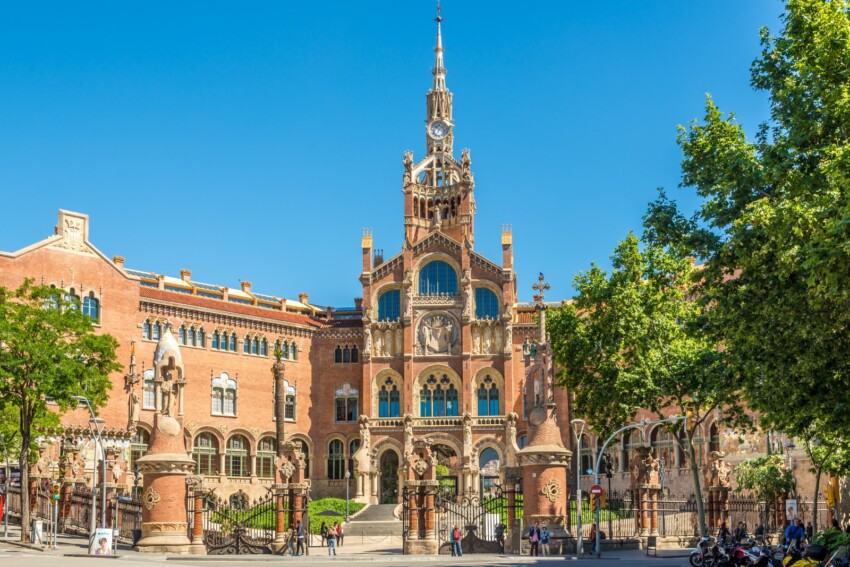
The original building dates back to 1401: it was a hospital for treating plague victims. Until 1904 it was the main welfare institution in the Principality of Catalonia, but in those years a feeling began to arise that the hospital was too closely linked to religion; doctors themselves began to criticise the hospital’s operation and its subordination to religious interests.
The construction of a new building in the early 20th century was financed by the donation of the banker Pau Fil to build a hospital that would help the city. To come closer to the patron’s wishes, the name Pau (Pablo in Spanish) was added to the hospital, which from that moment on was officially called Hospital de la Santa Creu i Sant Pau, although in colloquial language it is better known as Hospital de Sant Pau (or Hospital de San Pablo).
The Recinte Modernista de Sant Pau is located in the El Guinardó neighbourhood, at the intersection of Carrer de St. Antoni Maria Claret and Carrer de Cartagena streets. Opposite the entrance is a bus stop, where the 191, 192, N0 and V23 lines stop, while the metro stop is one block away; it is called Sant Pau – Dos de Maig, and the L5 line passes through it, which also passes by the Sagrada Familia and Casa Milà.
It is unthinkable to walk there from the Port Vell area, as it is about an hour and a quarter from the Columbus Monument at the end of Las Ramblas, but if you are near Sagrada Familia the walk is definitely doable: it will only take you 15 minutes walking along Avinguda Gaudí heading north.
The Hospital de la Santa Creu i Sant Pau is located in the El Guinardó district, north of the Sagrada Familia.
City Card allow you to save on public transport and / or on the entrances to the main tourist attractions.


 Hotel
Hotel  Budget accommodations
  Apartments
  Family Hotel
  Luxury Hotel
  Resorts