Bestseller
RCDE Espanyol Stadium Tour
From 17,00 €
Buy the ticket
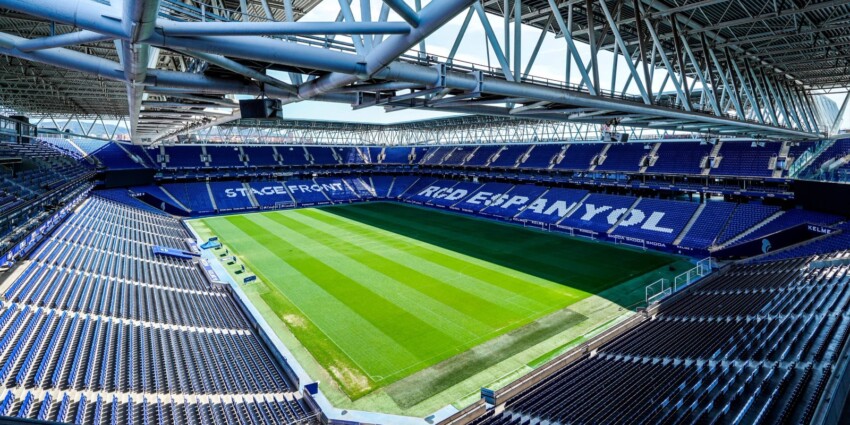
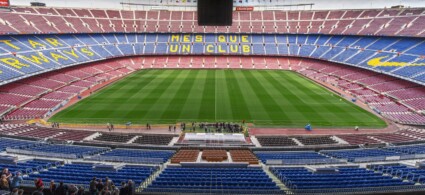
The Cornellà-El Prat Stadium, also known as RCDE Stadium or Stage Front Stadium (for sponsorship reasons), is located within the metropolitan area of Barcelona, in the municipality of Cornellà de Llobregat, not far from the city airport. It is now the home ofEspanyol, the city’s second largest football club after Barcelona FC, after it abandoned its historical home, the Olympic stadium of Montjuic.
The Cornellà-El Prat Stadium has a capacity of 40,500 seats, all covered, its construction cost was estimated at 95 million euros and it covers an area of 182,000 square metres, of which 36,000 are dedicated exclusively to sports use and the others to mixed use, which among other things serve to accommodate 3278 parking spaces in the adjacent car park. The covered roof of the stadium houses photovoltaic panels capable of producing over one million watts of power. Gate 21 was officially dedicated to Daniel Jarque, by virtue of the shirt number he wore.
The Cornellà-El Prat stadium is one of the first stadiums in Europe to use exclusively clean energy. It generates energy savings by using innovative technology to reduce the consumption of water and electricity, and harnessessolar energy, the excess of which is fed back into the Spanish electricity system, thus generating an additional profit for the club estimated at around EUR 600,000 per year. For this, the stadium was awarded the accolade of best sports facility of the year.
In 2002 Espanyol bought the land for 360,000 euros and 1% of the club’s share capital, which amounted to 150,000 euros. Construction work began on 9 May 2003, and the inaugural match took place on 2 August 2009. The stadium was named Cornellà-El Prat due to its location on the border between the municipalities of Cornellà and El Prat.
After the death of Espanyol captain Daniel Jarque i Gonzalez, who died of a heart attack on 8 August 2009 at only 26 years of age in Coverciano, in the province of Florence, fans clamoured to rename the stadium in his honour. However, to this day the club has still not taken a clear position on the matter: the Cornellà-El Prat stadium was later named Power8 Stadium for sponsorship reasons, while in January 2016, when the contract with Power8 expired, it took on the official name of RCDE Stadium, where RCDE stands for Real Club Deportivo Espanyol, the full name of the team. It is now officially called Stage Front Stadium, for sponsorship reasons.
The opening match of the stadium was a triumphant Espanyol-Liverpool 3-0, played on 2 August 2009. The first goal in the stadium’s history was scored by Luis Garcia (the other two goals were scored by Israeli Ben Sahar). This was the last match played by Daniel Jarque before his tragic death a few days later.
It is possible to take part in a guided tour of the RCDE stadium, specially designed for football fans and others. Modernity and tradition come together in this experience that will allow you to discover the passion from which the club was born and its history, present in every single corner of the stadium.
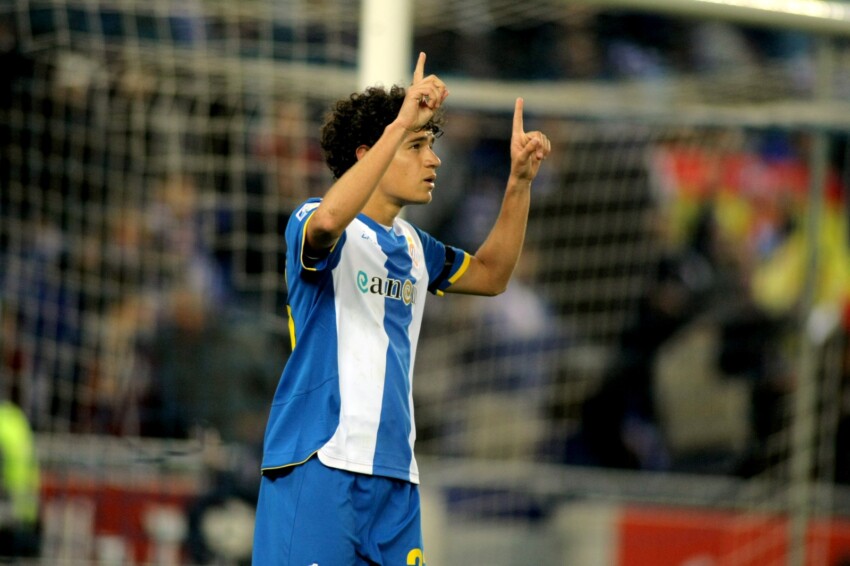
The Reial Club Deportiu Espanyol de Barcelona, also known as RCD Esp anyol or simply as Espanyol, is a football team from Barcelona. Culturally, it is the city’s ‘second’ team, the first of course being the much more titled Barcelona FC, whose ranks include world-famous players and boasts an almost endless collection of cups and trophies.
Espanyol, on the other hand, plays the uncomfortable role in the city of second team, less famous, less titled, less important. But its fans have a huge heart and do not accept playing second fiddle in the city.
RCD Espanyol was founded in 1900 and plays in La Liga, the top division of Spanish football. Although they cannot compete against their city rival, they have nevertheless won the Copa del Rey four times, most recently in 2006, and reached the final of the UEFA Cup in 1988 and 2007. The team plays at the Cornellà-El Prat stadium, whereas previously it defended its home walls first at the Sarrià and then at the Olympic Stadium in Barcelona, the city’s true emblem.
RCD Espanyol was founded on 28th October 1900 by Angel Rodriguez Ruiz, an engineering student at the University of Barcelona. Originally, the club was located in the affluent district of Sarrià and was known as Sociedad Espanola de Football. A year later, the club changed its name to Club Espanol de Futbol. Espanyol was the first club in Spain to be formed exclusively by Spanish fans.
In 1910, the club changed its name to Club Deportivo Espanol, choosing white and blue as its official colours, in homage to the colours on the Sicilian-Aragonese shield of the great Admiral Roger de Lluria, who sailed the Mediterranean to protect the interests of the Crown of Aragon in the Middle Ages. In 1912, the then King of Spain Alfonso XIII gave patronage to the team, which could then be called Real Club Deportivo Espanol.
With the declaration of the Second Spanish Republic, due to the ban on royal symbols, the club adopted the more Catalan/Republican name Club Esportiu Espanyol. After the Spanish Civil War, the name returned. Later, in February 1995, the club took the Catalan spelling. The word Deportiu in ‘Reial Club Deportiu Espanyol de Barcelona’ is the Catalan form of the original Spanish word Deportivo, although the correct word is Esportiu in the Catalan language. This choice was made in order to keep the initials RCD in the club’s name.
The historical home of RCD Espanyol is the Sarrià stadium, which was demolished in 1997. The club then decided to move to the Olympic Stadium in Montjuic. After 12 years, RCD Espanyol then moved to the Cornellà-El Prat stadium, which was officially inaugurated on 2 August 2009 with the match between Espanyol and Liverpool, with a crushing 3-0 victory.
Despite their reputation as the eternal runners-up in the city, RCD Espanyol have taken home several trophies in their history, starting with the four Copa del Rey in 1929, 1940, 2000 and 2006, as well as the pre-war Catalan Championships and the Copa Catalunya. It counts numerous appearances in the UEFA Cup where it reached the final in 1988, defeated by Bayer Leverkusen, and in 2007, defeated by Sevilla on penalties.
RCD Espanyol’s historic rival is Barcelona FC, for both parochial and political reasons. The Blue and Whites are in fact one of the clubs that have the patronage of the royal house, were founded exclusively by Spanish fans and the team’s founding message is to be clearly anti-Barcelona.
The rivalry has been reinforced by what Catalans see as a provocative representative of Madrd’s central government. During the dictatorships of Miguel Primo de Rivera and Francisco Franco, Espanyol was seen by the vast majority of Barcelona’s citizens as a club that cultivated a kind of understanding with the central authorities, in stark contrast to the revolutionary spirit of Barcelona FC. This sentiment actually contrasted with the fact that Franco gave financial support to the blaugrana; Espanyol from then on saw an increasing number of supporters among people close to the regime such as policemen, military officials, fascist party adherents and state workers.
The Cornellà-El Prat stadium is located along Avinguda del Baix Llobregat, within the municipal territory of Cornellà de Llobregat, now completely merged with the municipality of Barcelona.
City Card allow you to save on public transport and / or on the entrances to the main tourist attractions.

 Hotel
Hotel  Budget accommodations
  Apartments
  Family Hotel
  Luxury Hotel
  Resorts