Hotel Lloret Ramblas
Barcelona - Rambla Canaletes, 125
Book now
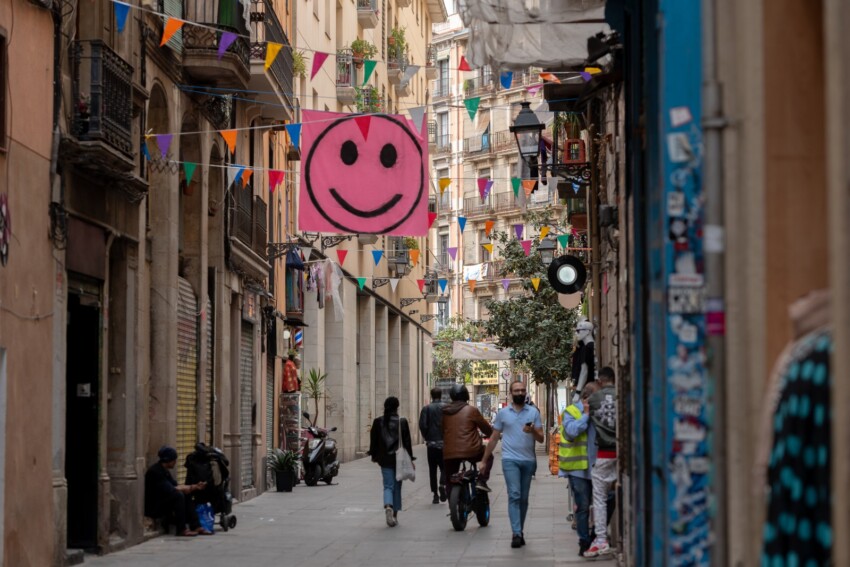
For centuries, the westernmost area of the old city, beyond Las Ramblas, was called Barrio Xino by the Barcelonians.
A nickname, between Castilian and Catalan, that the neighbourhood had earned both for the presence of oriental immigrants and for its overcrowding. The appellation endured for several decades, framing the area as infamous and dangerous, frequented mainly by immigrants, drug dealers and people from whom it was better to stay away.
In 1995, however, thanks to the construction of the MACBA, something changed. The area has since begun an architectural and partly social change that continues to this day.
Since then the neighbourhood has been called Raval and although it still retains many of the characteristics of a poor and simple area, it has been able to renew itself by shaking off its reputation as a bad area, renewing itself as an alternative area, full of art galleries and less formal clubs.
Today it is possible to walk through this district with relative tranquillity, often marvelling at how old and new can coexist, people in ties next to old prostitutes, ramshackle apartment blocks next to new buildings, small shops run by Asians instead of old brothels, dark alleys with smoky bars next to brand new art galleries.
It is a neighbourhood that should definitely be visited, for its uniqueness and to rediscover sides of Barcelona that you won’t see anywhere else.
El Raval is a slice to the west of the centre of Barcelona that covers a handful of square kilometres. It is bordered to the east by La Rambla, to the south by Avinguda del Parallel and to the north by Gran Via de Les Corts Catalanes; to the west, its boundary merges with that of the adjacent Sant Antoni district.
Thanks also to the fact that El Raval over the years has blended in with the urban fabric of the adjacent neighbourhoods, there are many and varied things to see in the area.
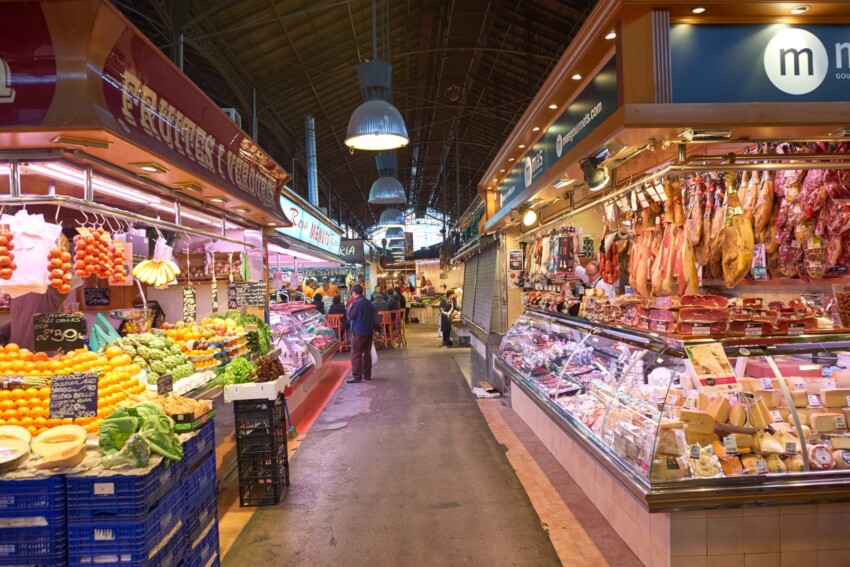
The Boqueria market is a perfect example of this: its entrance is located along Las Ramblas, i.e. right on the street that demarcates the border between the Barrio Gotico and El Raval. Thus, an attraction like this, one of the most incredible in Barcelona, is part of this former infamous neighbourhood.
At the Boqueria market you will be enchanted by the colours of the fresh fruit perfectly placed on the stalls, the sweetness of the smoothies that you can buy on the spot for a few pennies, the beauty and originality of the local gastronomic specialities served in seemingly improvised stalls that hide centuries-old histories, and much more. This covered market is one of the most beautiful in Europe, frequented by tourists but also by locals, who know very well that it is here that you can buy the best fresh fish in the area and many local delicacies at prices that are very much in line.
The Boqueria market can be accessed from La Rambla, a stone’s throw from the Liceu metro stop, or from the entrance at the back overlooking Placa de la Gardunya. Remember that it is closed on Sundays, so plan your visit accordingly
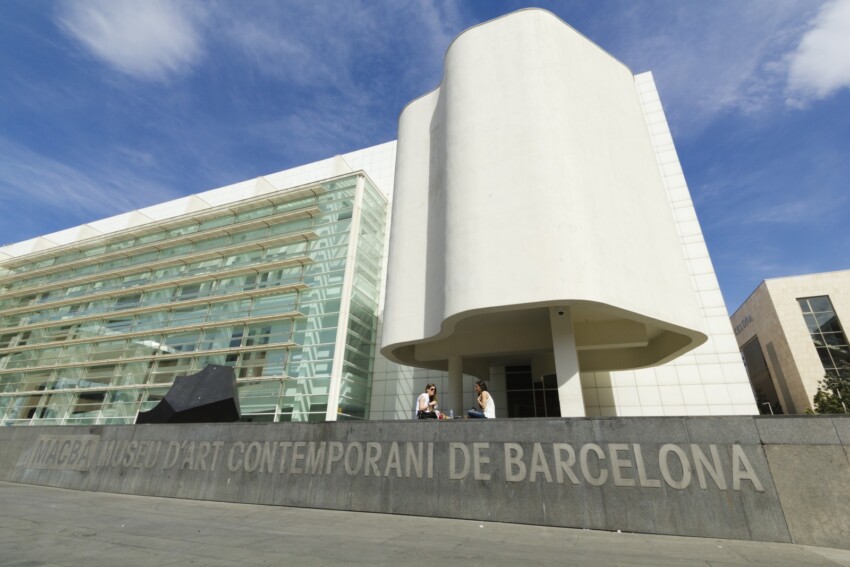
The MACBA is one of the main architects of the revival of the Raval. This museum, one of the most important in Barcelona, managed to breathe new life into the neighbourhood when it opened in 1995, bringing in a good number of tourists. Acronym for Museu d’Art Contemporani de Barcelona, the MACBA houses contemporary art works covering a period from the second half of the 20th century to the present day. Alongside the traditional exhibition, the museum also promotes research and education activities.
It is also very nice just to visit the MACBA from the outside, as it is housed inside a large, white, luminous building designed by architect Richard Meier, the same architect who created the Ara Pacis Museum in Rome. But if you can and if you are an art lover, enjoy it from the inside as well, and above all go back there, because at MACBA the collection is constantly evolving, in line with the dictates of contemporary art: in constant ferment.
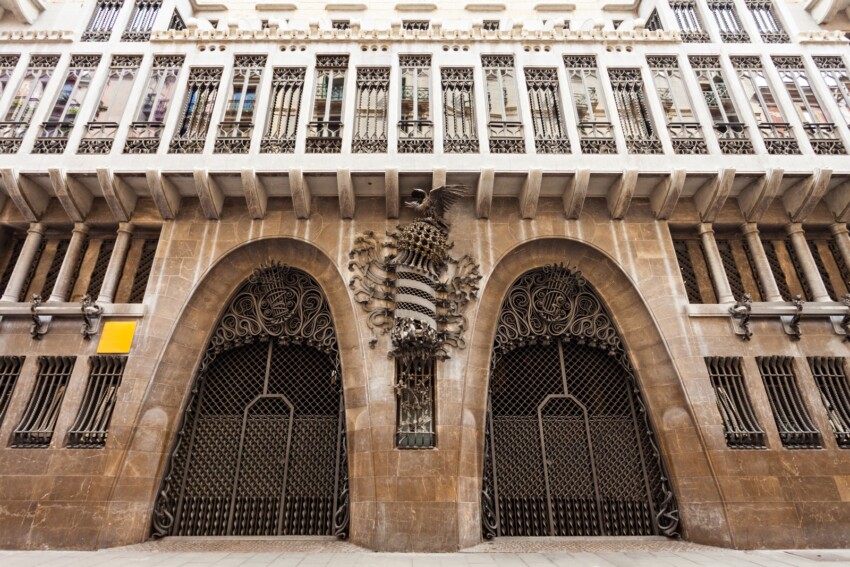
The Palau Güell is a structure in Barcelona designed by the architect Antoni Gaudí, which has been designated a UNESCO World Heritage Site due to its historical and cultural value.
It is a magnificent example of Gaudí’s feverish architectural imagination: this extraordinary neo-Gothic palace, one of the most important buildings of that era built in the Ciutat Vella, gives an idea of the prodigious genius of its author. Gaudí built the palace not far from Las Ramblas in the late 1880s for his wealthy and loyal patron, the industrialist Eusebi Güell. Although somewhat gloomy compared to some of his later works, it is still a riot of styles (Gothic, Islamic, Art Nouveau) and materials.
After the civil war, the police used the Palau Guell to torture political prisoners in the basement. The building was later abandoned, which led to its ruin. In 2012 it reopened in its entirety after several years of work and renovation.
A curiosity: Pablo Picasso – who, incidentally, detested Gaudí’s work – started his Blue Period in 1902 in a studio across the street on Carrer Nou de la Rambla at number 10. In contrast to Picasso, UNESCO has declared the Palau Güell , along with Gaudí’s other major works (La Sagrada Familia, Casa Batlló, la Pedrera, the Parc Güell, Casa Vicens and the crypt of Colonia Güell) a World Heritage site.
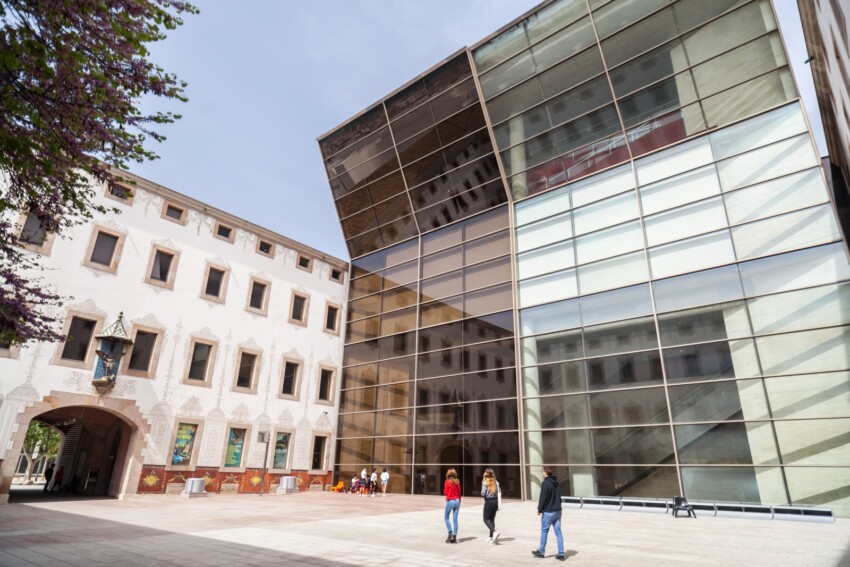
The Centro de Cultura Contemporanea de Barcelona, also known in the city by its initials CCCB, is one of the most visited cultural and exhibition centres in the city of Barcelona.
It is located in the Raval area, halfway between Plaça de Catalunya and University Square, and has the city and urban culture as its central idea. It bases its success on quality, a certain eclecticism and a focus on a wide audience; its function is to link academia with the creation of culture and the problems of citizens.
The Centro de Cultura Contemporanea de Barcelona was inaugurated on 25 February 1994 and its original purpose was to be a multidisciplinary institution dedicated to the study of the city and everything that revolves around it. It is constituted as a consortium formed by Barcelona City Hall and the Diputació, the equivalent of the city’s provincial council.
The centre produces and organises exhibitions, festivals, concerts, film festivals, conferences and courses, which generate debates and reflections on the city and public spaces, as well as on topical issues.
Similarly, a wide variety of materials can be consulted at theCCCB archive, ranging from documents to publications, from digital archives to audiovisual material, all of which have contemporary culture and society as their central theme.
The CCCB Lab is a department of the Centro de Cultura Contemporanea de Barcelona created in 2010 as a space dedicated to transformation and innovation in the field of culture. Its objectives are to investigate and propose guidelines for content and forms of public presentation in accordance with current society.
On the CCCB Lab’s blog, it publishes thought-provoking articles, video lectures and in-depth discussions by specialists in areas such as cultural innovation, the relationship between science and culture and even modern technologies such as Big Data.
The Centro de Cultura Contemporanea de Barcelona covers an area of 15,000 square metres, 4,000 of which are used as exhibition space. It is also equipped with an auditorium, a library and several multi-purpose rooms. The CCCB occupies part of the Casa de Caritat, built in 1802 and in use until 1957. Adaptation work was supervised by architects Helio Pinon and Albert Viaplana, and in 1993 the project was awarded the Ciutat de Barcelona architecture prize.
The recent CCCB extension project has seen efforts concentrated on the north wing, completing the original building with a 30-metre high prism with a glass façade reflecting the courtyard at the top.
In spring 2011, the Centro de Cultura Contemporanea de Barcelona incorporated the recently renovated old Casa de Caritat theatre. The project incorporates the Pati de les Dones courtyard and the old theatre dating back to 1912.
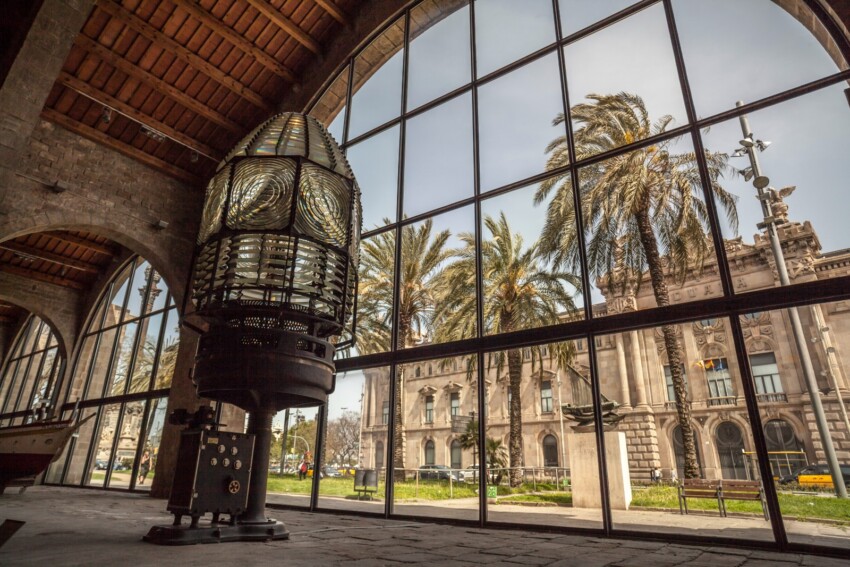
The Maritime Museum, Museu Maritim in Catalan, also known in the city by its acronym MMB, is certainly one of the most interesting places in Barcelona. It is located inside the building of the Drassanes Reials de Barcelona (Royal Shipyards of Barcelona), a space specifically dedicated to shipbuilding and used between the 13th and 18th centuries.
The Museu Maritim is located at the southern edge of the historical centre and at the end of La Rambla. Walking right at the end of the city’s most famous pedestrian street, one may notice this interesting museum almost by chance. In fact, the building is probably the most interesting part of the visit: with its large bays and Gothic façade, it is an extraordinary example of medieval architecture and solid evidence of a time when Barcelona had the Mediterranean under its control.
The Museu Maritim is an institution dedicated to the culture of the sea with more than 800 years of history. Its mission is to preserve, study and promote the country’s maritime heritage, one of the richest in the Mediterranean. It is located in the building of the Drassanes Reials de Barcelona, on the city’s seafront, at the foot of the Montjuic mountain.
The Drassanes Reials de Barcelona were listed in 1976 as a historical-artistic monument due to their wide historical significance in the world of shipbuilding. The conservation function of the heritage is managed today by the Consortium of Drassanes Reials, formed by the City Council of Barcelona, the Provincial Council and the Port Authority.
The founding Council of theMediterranean Nautical Institute led to the creation of a maritime museum with a naval library, since the Barcelona School of Nautical Studies, founded in 1769, already possessed a collection of models and instruments. This collection and the attached museum would become the basis of what is now the Royal Shipyards of Barcelona in 1935, after the abandonment of the occupying military institutions.
Inside the Museu Maritim is a gallery with popular works of art. Since 1999, the museum has been open to the city, using part of its space to host various events, exhibitions and other educational activities. In 2006, Barcelona’s Museu Maritim was declared a Museum of National Interest and in October 2009, the restoration of part of the Royal Shipyards began. The new museum was inaugurated in February 2013, and a Roman necropolis was also discovered during the works.
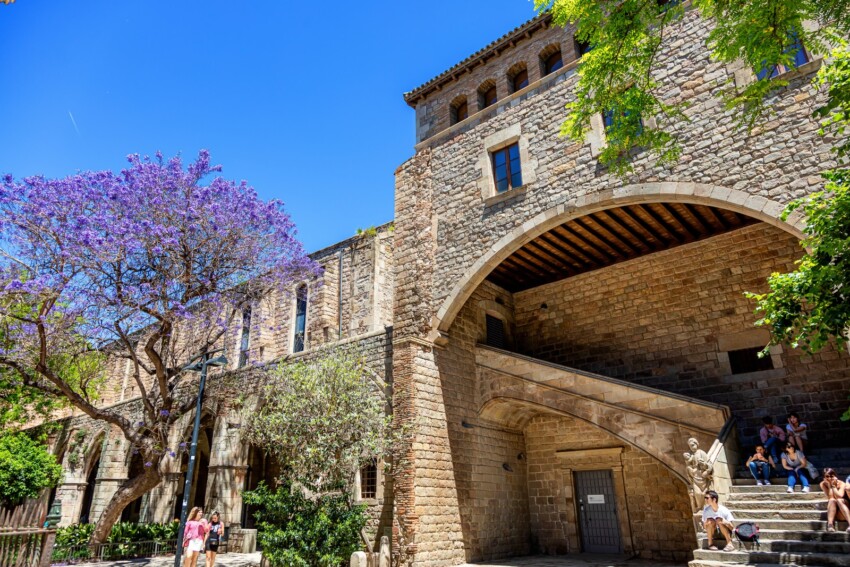
TheAntic Hospital de la Santa Creu is a collection of buildings that were part of Barcelona’s main hospital until the last century. It is an architectural ensemble of green courtyards, frescoed rooms housing the library of Catalonia (Biblioteca de Catalunya, in its original language), art schools and even cultural spaces.
On the first floor is the Biblioteca de Catalunya, and as soon as you cross its threshold, an open-plan, column-free space opens up: this is where the hospital wards were located.
The rooms have high wooden ceilings, but those on the first floor, which house two public libraries, have Gothic vaults and were used to house the administration, kitchen and laundry.
The Antic Hospital de la Santa Creu is completed by the former rest home, the Casa de la Convalescència, now home to the Institut d’Estudis Catalans, the Reial Academia de Medicina and the former hospital chapel, now converted into an exhibition space.
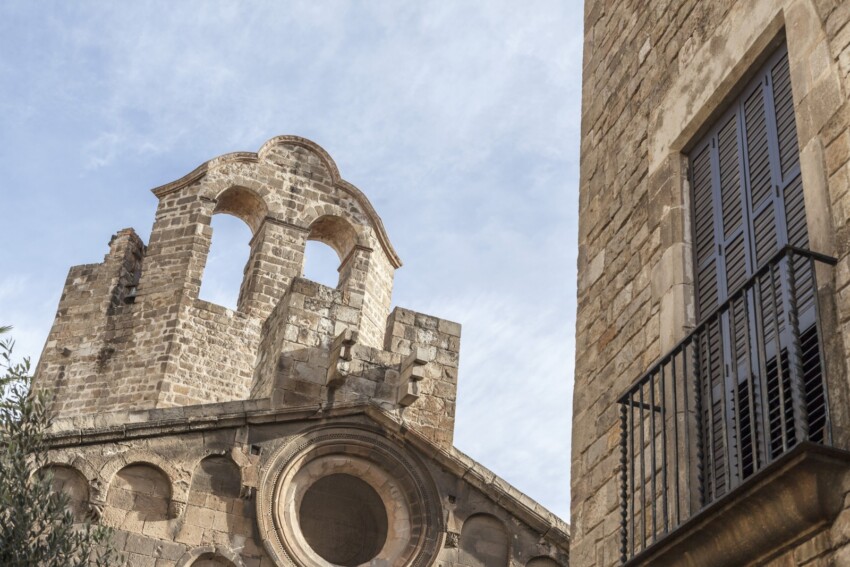
A Romanesque church in the heart of the El Raval district, theEglesia de Sant Pau del Camp is one of the oldest churches in the city, initially founded as a Benedictine convent in the 9th century, then rebuilt in the following centuries. Its name, which translated into Italian sounds like ‘church of Saint Paul of the Camp’, gives one pause for thought: in fact, before the 14th century the place on which it is built was open countryside. Today, seven hundred years later, it has been totally incorporated into the urban area of Barcelona.
The convent also has a small 14th-century cloister, with arcades supported by double columns and capitals decorated with biblical and natural scenes. The church, on the other hand, has a Greek cross plan with a single nave and beautiful barrel-vaulted ceilings.
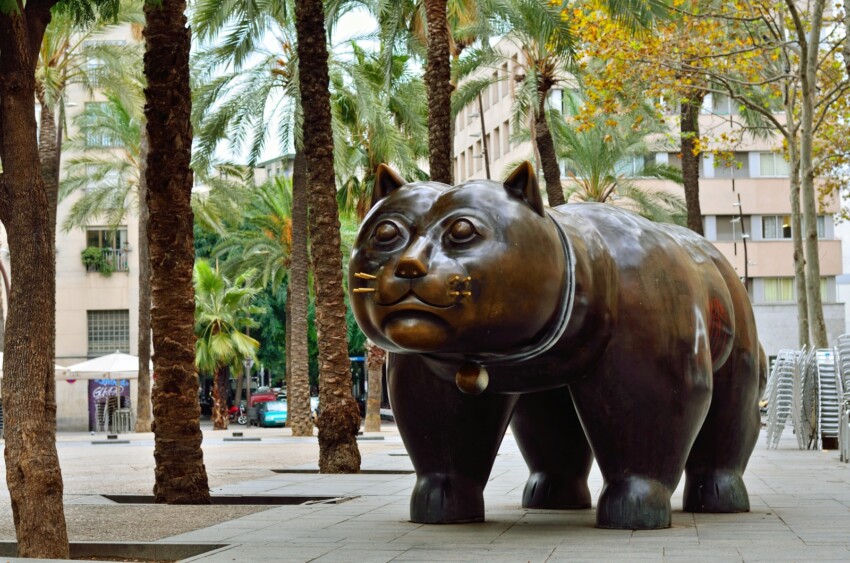
In an attempt to recreate a copy of the Rambla, the Rambla del Raval is a street lined with palm trees replacing two dark and desolate streets that were here until a few years ago. Neighbourhood festivals are also held here and part of the celebrations on 24 September, Mercè day, which is very popular in Barcelona.
Shops, bars and cafés line this street, a worthy ‘cousin’ of the original Rambla. A real surprise, especially for those who think Barcelona outside the tourist centre has little to offer. About halfway down the Rambla del Raval is El Gat, or ‘the Cat’, a work by Fernando Botero. Also, on Saturdays and Sundays, except in August, the Mercat Raval, an open-air market with stalls selling costume jewellery, decorations, clothes and typical food, runs practically all day long.
Carrer Nou de la Rambla, or Calle Nueva de la Rambla in the now obsolete Castilian version, is the main street of the El Raval district, bursting with vitality thanks to its restaurants, shops and grocery shops. Dating back to the late 18th century, the street was once home to brothels, cabarets and nightclubs, some of which have retained their old décor. These include the Eden Concert, one of the city’s first cinemas, and the Bagdad Club, which is still very active today.
Along Carrer Nou de la Rambla is also the Palau Guell, so walking along this street you can visit two attractions in one in the Raval!
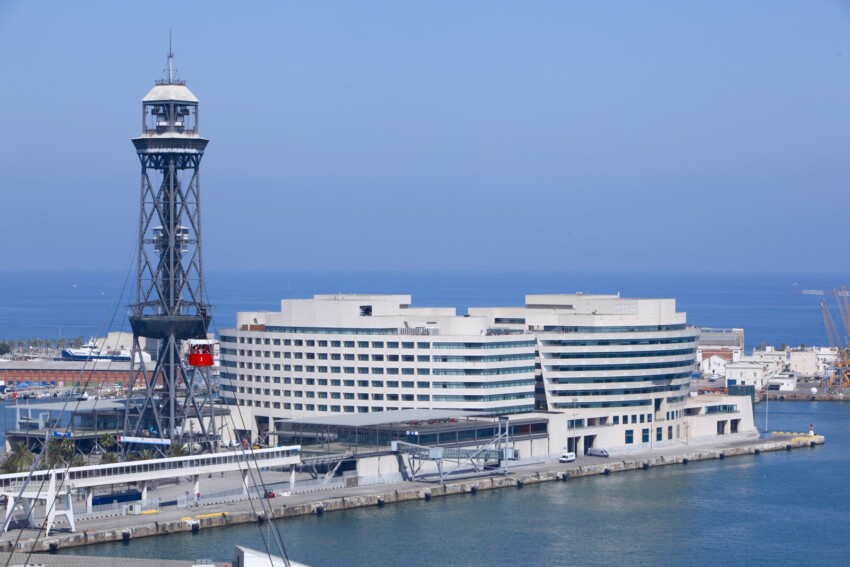
After Placa de les Drassanes, overlooking the sea in the middle of the port area, the World Trade Centre Barcelona awaits you. This imposing circular structure houses offices, conference rooms, the five-star Grand Marina hotel, the renowned Ruccula restaurant and a number of gift shops.
Opened in 1999, it covers an area of 40,000 square metres, and its curious shape is inspired by those of the ships that ply the Mediterranean, at least according to the architect Henry Cobb who designed it. In all, the World Trade Center Barcelona is made up of four buildings, which, placed in a circle, create a central courtyard where a fountain jets water at different speeds.
Next to the World Trade Center is a cable car, called the Teleferico del Puerto, which terminates at the Terraza Miramar on Montjuic Hill (note: do not confuse this with the actual Teleferica de Montjuic, which runs an entirely different route). You can board the iconic red cable car and enjoy splendid views from the top of the Jaume I Tower.
In the following map you can see the location of the main places of interest mentioned in this article.
El Raval is a rather large neighbourhood, but its location very close to the centre means that practically every accommodation has the convenience of being able to get around Barcelona without too much dependence on public transport. The northernmost area of the district is the one that approaches Gran Via de les Corts Catalanes and Placa Catalunya, and is therefore denser with tourists and more convenient with respect to public transport, and perhaps a little more upmarket. The southernmost area, on the other hand, is more traditional, more ‘real’ in a certain respect, and could not be otherwise as it has been the dockworkers’ quarter for years. However, even in this area there is no shortage of accommodation, and for all your travel needs, the Drassanes metro stop is just a stone’s throw away.
If, on the other hand, you want to experience the heart of the district, choose to sleep on the Rambla Del Raval, which is actually a square, albeit a very elongated one: it is the site of Botero’s famous Cat, one of the area’s iconic sculptures.
El Raval is the district of Barcelona located just south of the Barrio Gotico, across the Rambla. Roughly speaking, it stretches from the port to the Gran via de les Corts Catalanes.
City Card allow you to save on public transport and / or on the entrances to the main tourist attractions.


 Hotel
Hotel 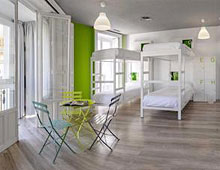 Budget accommodations
 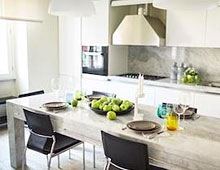 Apartments
 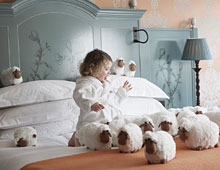 Family Hotel
 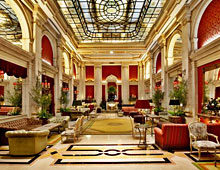 Luxury Hotel
  Resorts