Bestseller
Gaudi's Crypt in Colonia Güell with Audioguide
From 10,00 €
Buy the ticket
The Colonia Güell is a small urban agglomeration located in Santa Coloma de Cervellò, just outside Barcelona. It is considered an excellent destination to study the architecture of Antoni Gaudi and is at the same time one of the most important tourist attractions in Catalonia.
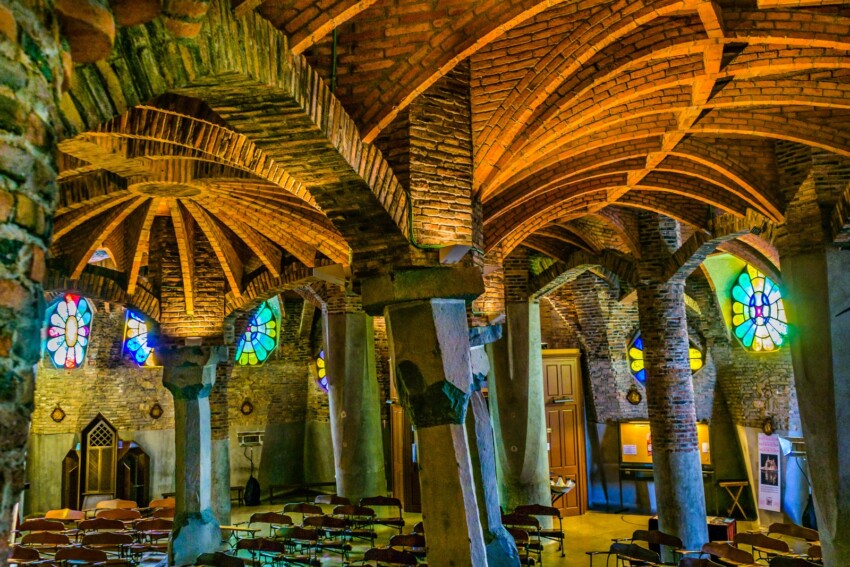
The Colonia Guell is an excellent example of modernist style applied to the field of civil and industrial architecture. Its interior contains the most characteristic signs of this movement: firstly the use of bricks, traditional in Catalan architecture, and secondly the incorporation of new techniques and new building materials such as iron or ceramics.
Gaudí’s work focused on the construction of the crypt, the high point of the famous Catalan architect’s creative work. It incorporates for the first time almost all of his architectural innovations such as arches, the use of shaped external walls, the dynamic and fluid treatment of space and the building’s internal mechanisms that blend in with the natural environment. As Gaudi said, if the church was finished, it would be a “monumental model of the Sagrada Familia“.
The Crypt is also known as ‘the church of inclined columns’, is considered Gaudi’s workshop and has been a UNESCO Site since 2005.
In Francesc Berenguer ‘s buildings one can admire a very personal treatment of decorative elements, such as the moderate use of ceramics, the arrangement of bricks and wrought iron.
In Joan Rubió’s buildings, brick becomes the protagonist and is used to allow different solutions, both decorative and for the façades, as well as to form original structures. The plans of the buildings have a more complex design than those of Berenguer, such as Ca l’Espinal, by far the highest quality building within the Colonia Guell. The reinterpretation of past styles is evident in his buildings, incorporating elements of Gothic character.
The entrance ticket to the Colonia Güell includes a visit to the Gaudi Crypt and the Colònia Güell and an audio guide in Italian. It can be purchased online by clicking on the box below.
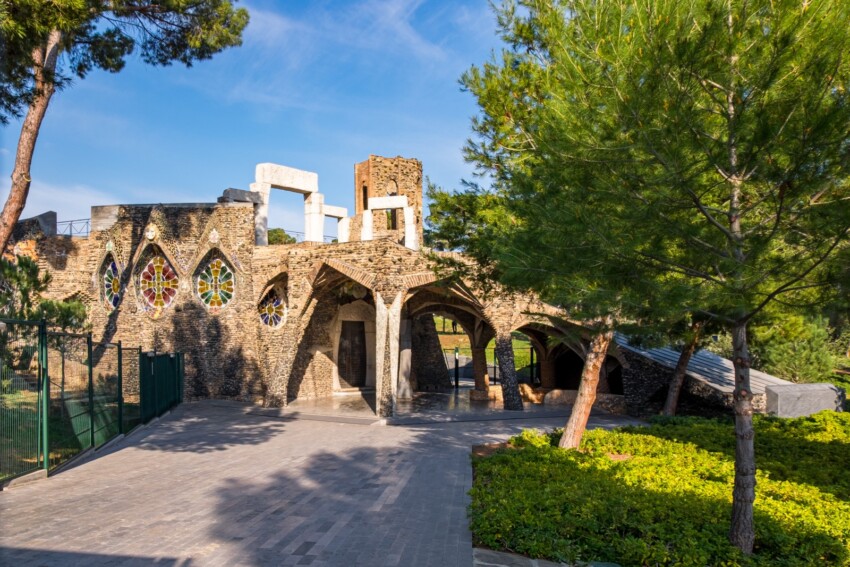
Unlike many other industrialists in Catalonia, Eusebi Güell wanted to provide better social conditions for the workers who worked for him. That is why in 1891 he started work on the Colonia Güell, an urban agglomeration with houses, cultural and religious buildings, incorporating the modernist current into the new constructions. The project had hospitals, schools, shops, theatres and houses for workers. The architect in charge of the entire urbanisation was Antoni Gaudí, with the help of his trusted assistants Francesc Berenguer and Joan Rubiò.
The factory that employed the inhabitants of Colonia Güell closed in 1973 at the height of a general crisis in the textile sector, producing a strong social impact on the entire urbanisation. In the following years the property went up for sale, the factory to different companies, the houses to its inhabitants and the surrounding land to public institutions.
Due to the richness of its historical and architectural heritage, in 1991 Colonia Güell was declared an Asset of Cultural Interest and protection of the most important buildings was established.
The Colonia Guell is located on Carrer Reixach in Santa Coloma de Cervellò, about 10 kilometres west of the centre of Barcelona.
City Card allow you to save on public transport and / or on the entrances to the main tourist attractions.

 Hotel
Hotel  Budget accommodations
  Apartments
  Family Hotel
  Luxury Hotel
  Resorts