Bestseller
Barcelona: Cathedral of Barcelona Entry Ticket
From 20,00 €
Buy the ticket
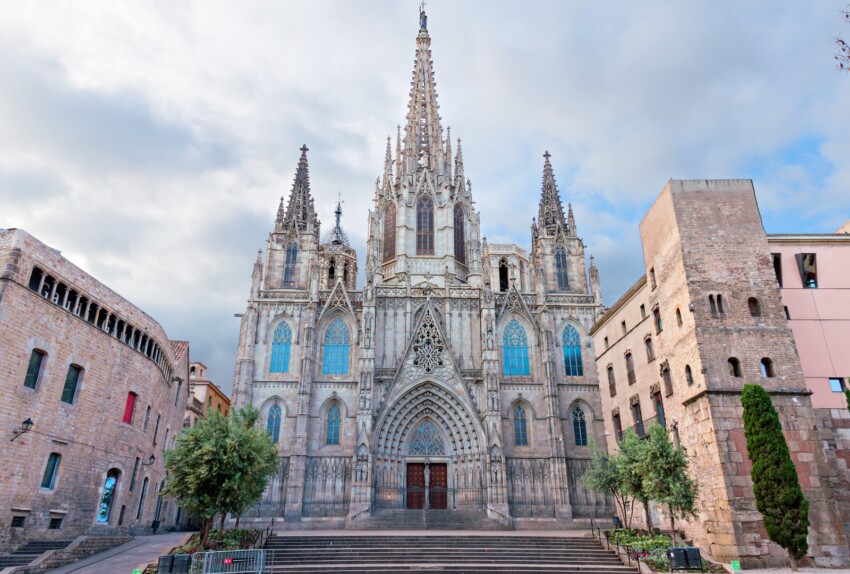
Barcelona Cathedral, whose official Catalan name is Catedral de la Santa Creu i Santa Eulalia and means ‘Cathedral of the Holy Cross and Saint Eulalia’, took this name in honour of Barcelona’s patron saint Eulalia. The commonly used name, La Seu, refers to the church’s status as the seat (seu in Catalan) of the diocese.
As early as 343 AD during the Roman Empire, a basilica was built at the present site of the cathedral on a site previously occupied by a Roman temple. In 985 the basilica was destroyed by the Moors. It is said that the Catalan Ramon Berenguer I, who began his reign in 1035 when he was only 11 years old, ordered the construction of a cathedral, which was later built between 1046 and 1058 in the Romanesque style.
A nearby chapel – the Capella de Santa Llucia – was built between 1257 and 1268 and later incorporated into the cloister of the cathedral. Due to civil wars and the ‘black death‘, i.e. the plague epidemic that struck the city several times, construction proceeded very slowly. It had to wait until 1460 for the main building to be completed.
The Gothic façade of Barcelona Cathedral was finished much later, only in 1889, and the last part, the central spire, was completed in 1913. The design of both the façade and the spire was based on the original 1408 drawing by French architect Charles Galters.
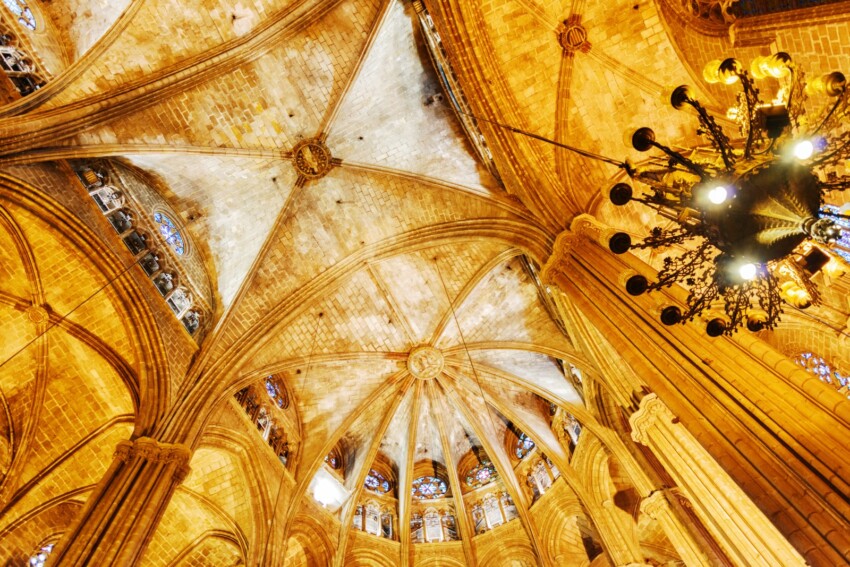
Barcelona Cathedral is 93 metres long and 40 metres wide. The octagonal bell towers reach a height of over 50 metres and were completed between 1386 and 1393. The spire of the central tower reaches a height of 70 metres and the main entrance to the church, lavishly decorated with statues, is reminiscent of the arcades of the great French cathedrals.
The interior of Barcelona Cathedral consists of a wide nave lit by large stained glass windows dating back to the 15th century. The nave is flanked by aisles with no less than 28 side chapels. The crypts house the tombs of Count Ramón Berenguer I and his wife, while one of the highlights inside the cathedral is the crypt below the Main Chapel (choir) containing the sarcophagus of Santa Eulalia. The cathedral is famous for its 14th-century cloister, with a central courtyard surrounded by a wonderful Gothic portico.
The organ in Barcelona Cathedral accompanies Eucharistic celebrations and readings. This instrument has enormous historical, liturgical and artistic value. It is located inside the main nave, under the bell tower, and was built between 1537 and 1539. Its pipes are decorated with motifs designed by Pedro Pablo Serafin, and the entire installation was restored between 1985 and 1994.
Organ concerts have been scheduled every month since 1990 and have become very popular with the city’s faithful.
There are always thirteen geese in the cloister of the Cathedral. Each goose represents a year in the life of the martyr Saint Eulalia, a young girl tortured to death in the 4th century by the Romans for her religion and today the patron saint of the city of Barcelona.
To visit Barcelona Cathedral you need to buy an entrance ticket, which includes a visit to the church, access to the terrace, access to the Chapter House, entrance to the Museo Diocesano de Barcelona and a virtual audio guide.
Visits to the Barcelona Cathedral can be made every day of the year; apart from exceptions due to public holidays, the timetable is as follows:
The Capella de Santa Llucia is open daily for prayer from 12:45 to 17:45, accessible from Carrer de Santa Llucia.
Guided tours of Barcelona Cathedral can be organised by the Barcelona Diocesan Museum, located on Avenida de la Catedral, Tuesday to Sunday from 11:00 to 13:00.
Barcelona Cathedral is located in the heart of the Barrio Gotico, right in the historic centre. It faces Placa Nova and is easily reached by bus or taxi along Via Laietana.
City Card allow you to save on public transport and / or on the entrances to the main tourist attractions.


 Hotel
Hotel  Budget accommodations
  Apartments
  Family Hotel
  Luxury Hotel
  Resorts